Devon Rex Cat: Complete Breed Guide, Grooming Care, and Allergy Science
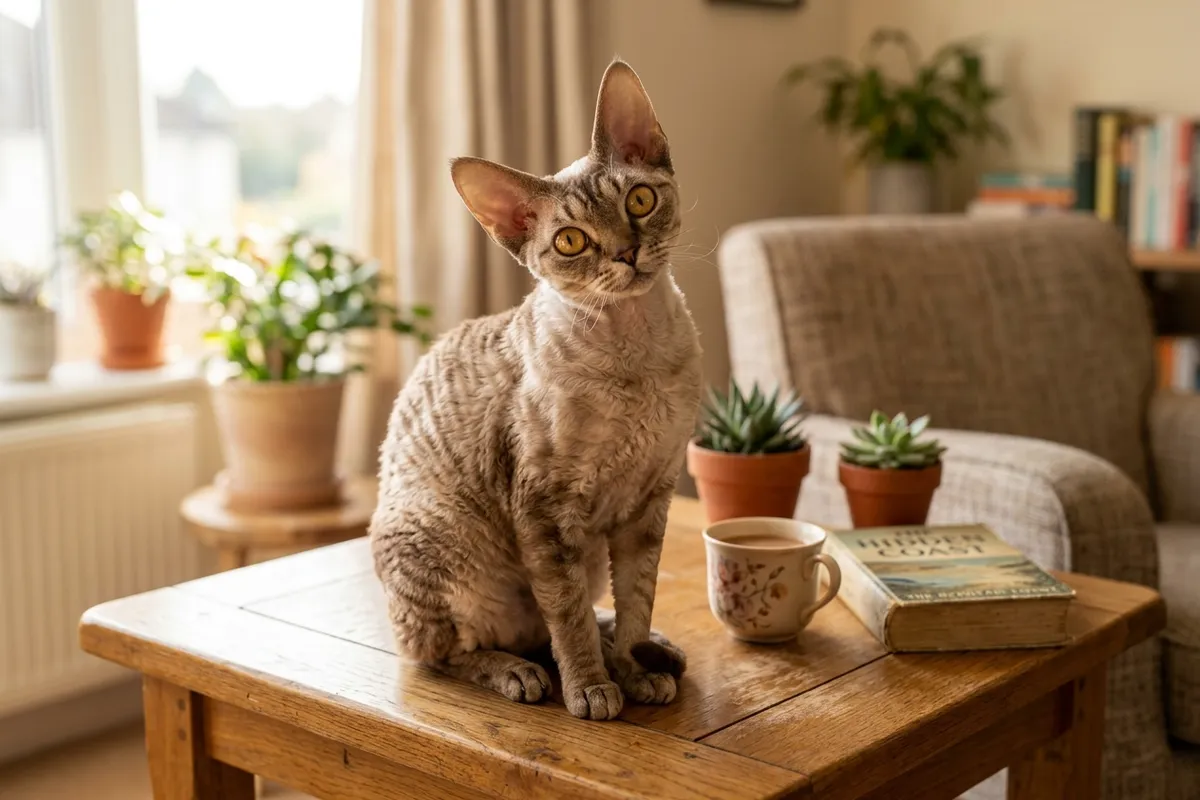
With its disproportionately large bat-like ears, sculpted cheekbones, luminous oval eyes, and an exquisite rippled coat as soft as crushed velvet, the Devon Rex instantly evokes the whimsical aura of a mischievous pixie or an otherworldly creature. Discovered in Devonshire, England, in 1960, this feline captivates not only with its unforgettable alien appearance and playful, puppy-like temperament, but also with its renowned status among cat lovers who suffer from feline allergies. Lacking a stiff protective guard coat and undergoing virtually imperceptible shedding, the Devon Rex disperses dramatically less dander and dried salivary allergen throughout the home.
In this guide
1. Origins and History: The Pixie of Buckfastleigh
In 1960, near an abandoned tin mine in Buckfastleigh, Devonshire, England, animal lover Beryl Cox spotted a distinctive feral tomcat sporting a coat of tight, rippling curls. Shortly thereafter, a stray calico cat gave birth in Cox’s garden to a litter featuring a brownish-black male kitten with the same wavy fur, whom she named Kirlee.
At first, felinologists assumed Kirlee shared the exact same curly genetic mutation as the Cornish Rex, which had surfaced ten years earlier in neighboring Cornwall. However, when Kirlee was test-mated with purebred Cornish Rex females, every resulting kitten displayed straight, normal coats. This revelation proved conclusively that Kirlee carried a distinct, novel recessive genetic mutation (designated as the k allele, differing from the Cornish r allele).
```
┌─────────────────────────────────────────────────────────────┐
│ GENETIC DISTINCTION BETWEEN BRITISH REX BREEDS: │
│ │
│ • CORNISH REX: Mutation in LPAR6 (rex allele / r) │
│ • DEVON REX: Separate mutation in LPAR6 (k allele) │
│ • CORNISH x DEVON CROSS: 100% straight-coated offspring │
│ (independent non-complementing recessive alleles) │
└─────────────────────────────────────────────────────────────┘
```
Through careful outcrossing programs designed to broaden the gene pool and prevent harmful inbreeding, the Governing Council of the Cat Fancy (GCCF) granted championship recognition to the Devon Rex in 1967. The International Cat Association (TICA) followed in 1979, and the Cat Fanciers' Association (CFA) officially accepted the breed in 1983.
---
2. Physical Characteristics and Breed Standard
The physical morphology of the Devon Rex is completely unique in the domestic feline world:
```
┌─────────────────────────────────────────────────────────────┐
│ DEVON REX BREED MORPHOLOGY STANDARD: │
│ │
│ • HEAD: Short modified wedge with prominent cheekbones │
│ • PROFILE: Distinct nasal stop with a short muzzle │
│ • EARS: Enormous, set very low, broad at the base │
│ • EYES: Large, oval, set wide apart, expressive gaze │
│ • BODY: Medium-sized, broad chest, slender yet muscular │
│ • LEGS: Long, slender, ending in neat oval paws │
│ • COAT: Short, fine, rippled/waved, lacking guard hairs │
│ • WEIGHT: Females 2 - 3.5 kg (4.5-8 lbs) | Males 3 - 4.5 kg│
└─────────────────────────────────────────────────────────────┘
```
The Anatomy of the Rippled Coat
Normal cat fur features three distinct hair types: outer guard hairs, awn hairs (intermediate), and down hairs (undercoat). In the Devon Rex, primary guard hairs are virtually absent or stunted. The coat consists almost exclusively of fine awn hairs and velvety down, creating a delicate, crimped texture reminiscent of sheared mouton fleece. Its whiskers and eyebrows are similarly crinkled, brittle, and short.
All color varieties and coat patterns are recognized, including solid tones (black, white, blue, red, cream), tabby, tortoiseshell, smoke, and pointed colorations (frequently referred to as Si-Rex).
---
3. The Hypoallergenic Reality: Why Allergy Sufferers Cope Better
Popular lore frequently mischaracterizes the Devon Rex as completely non-allergenic. Immunologically speaking, Devon Rex cats still produce the Fel d 1 protein. However, clinical experience confirms that many allergic individuals experience far milder or no symptoms living alongside a Devon Rex due to three physical mechanisms:
- Near-Zero Shedding: Lacking dense guard hairs and excessive coat volume, the Devon Rex drops minimal hair. Dead fur does not float through indoor air or embed itself in carpets, upholstery, or bedding.
- Reduced Allergenic Surface Area: With substantially less coat volume, the total amount of saliva deposited during grooming remains low, yielding a drastically reduced reservoir of dried allergen.
- Effortless Surface Cleansing: Wiping the cat’s coat once or twice weekly with a damp microfiber cloth or hypoallergenic pet wipe swiftly removes accumulated dander before it disperses into the ambient air.
> [!TIP]
> Practical Allergy Management: Equip living spaces with true HEPA air purifiers and vacuum carpets with sealed HEPA filtration. Maintain the master bedroom as an allergen-free sanctuary by keeping bedroom doors closed to pets.
---
4. Temperament, Personality, and Family Dynamics
Devon Rex owners universally describe the breed's personality as an enchanting hybrid of cat, dog, and playful monkey:
- Passionate Heat Seekers: With limited thermal insulation from their light coat, Devon Rex cats obsessively pursue warmth. They drape themselves around guardians' necks, climb inside fleece sweaters, and snuggle directly against your chest under duvet covers.
- Tireless Jesters: Highly energetic and endlessly playful into their senior years. They master games of fetch, happily ride on human shoulders, and execute daring aerial leaps from bookshelves.
- Gentle Communicators: While not as loud as Siamese cats, they chirp, trill, and emit gentle, rhythmic purrs to express affection and invite interaction.
- Social Compatibility: They wither in isolation. If family members work out of the home during the day, adopting a bonded companion (another Devon Rex, a friendly feline, or a cat-safe dog) is strongly recommended.
---
5. Grooming Care, Environment, and High-Metabolism Diet
The unique anatomy of the Devon Rex calls for specific daily care protocols:
Skin and Ear Hygiene
- Sebum Regulation: Without thick hair to absorb bodily oils, sebum can build up on the skin and nail beds. A warm sponge bath with pH-balanced feline shampoo once a month prevents greasy coat texture and dermatological irritation.
- Ear Canal Care: Due to their cavernous, open ear canals, Devon Rexes accumulate dark earwax more rapidly than standard cats. Inspect weekly and clean using veterinarian-approved ear rinses and cotton balls (never insert cotton swabs into the canal).
- Thermal Protection: In ambient temperatures below 19°C (66°F), provide heated pet pads or lightweight feline sweaters. In sunny seasons, protect light-colored Devon Rexes from prolonged sun exposure through windows to prevent actinic dermatitis.
High-Calorie Nutrition
Because their light coat radiates body heat rapidly, Devon Rex cats maintain a hyperactive metabolic rate. They burn calories swiftly and require energy-dense diets rich in top-tier animal proteins (exceeding 70% dry matter) and essential fatty acids (Omega-3 and Omega-6) to support healthy skin barrier function.
---
6. Veterinary Health and Hereditary Conditions
While structurally resilient and lively, the breed carries specific genetic susceptibilities that responsible breeders screen for:
- Devon Rex Congenital Myopathy (CMS / Spasticity): An autosomal recessive neuromuscular condition caused by mutations in the COLQ gene. It results in muscle fatigue, head bobbing, ventral neck flexion, and swallowing difficulties. DNA screening of breeding stock completely prevents affected offspring.
- Patellar Luxation and Hip Dysplasia: Slippage of the kneecap or shallow hip socket conformation, identifiable via routine orthopedic veterinary examinations.
- Malassezia Dermatitis: Opportunistic yeast overgrowth in skin folds, ears, and claw sheaths, driven by oil accumulation.
- Hypertrophic Cardiomyopathy (HCM): Thickening of the left ventricular heart muscle; periodic echocardiographic screening of breeding cats is recommended.
When cared for with attentive veterinary oversight and routine preventive wellness, Devon Rex cats enjoy a robust life expectancy of 12 to 16 years.
---
7. Frequently Asked Questions (FAQ)
Does a Devon Rex need a sweater in winter?
If your household indoor temperature drops below 19°C (66°F), a soft cotton or fleece sweater will keep your Devon Rex comfortable. Ensure warm heated beds or fleece blankets are always accessible.
Can you brush a Devon Rex?
Avoid harsh wire slicker brushes or stiff bristle combs, which can break the delicate curly hairs and scratch tender skin. Use a soft rubber massage mitt or a damp cloth to remove loose fuzz gently.
Can individuals with severe cat allergies live with a Devon Rex?
While many mild-to-moderate allergy sufferers live comfortably with the breed, severe cat-induced asthmatics may still react to residual Fel d 1. Always schedule in-person trials with an adult Devon Rex before committing to adoption.
---
8. Scientific Sources and References
- Governing Council of the Cat Fancy (GCCF): Devon Rex Breed Standard & History, GCCF Official Records, 2024.
- Cat Fanciers' Association (CFA): Devon Rex Breed Profile & Standard, CFA Guidelines, 2023.
- Gandolfi, B. et al.: The naked truth: Sphynx and Devon Rex cat breeds share mutations in the KRT71 and LPAR6 genes, Mammalian Genome, 2010.
- Martin, P. T. et al.: Congenital myasthenic syndrome in Devon Rex and Sphynx cats caused by a mutation in COLQ, Journal of Veterinary Internal Medicine, 2008.
- Bonnet, B. et al.: An update on molecular cat allergens: Fel d 1 and beyond, Allergy, Asthma & Clinical Immunology, 2018.
Caring for a cat? Keep their health in your pocket
Register your cat on Nekolife to track vaccination history, weight, and get advice from loving cat parents.
- Vaccine & weight records
- Supportive cat community
- Earn Meow Points & badges
Related pages
Know someone who needs this?