Balinese Cat: Complete Guide to Personality, Grooming, and Allergy Science
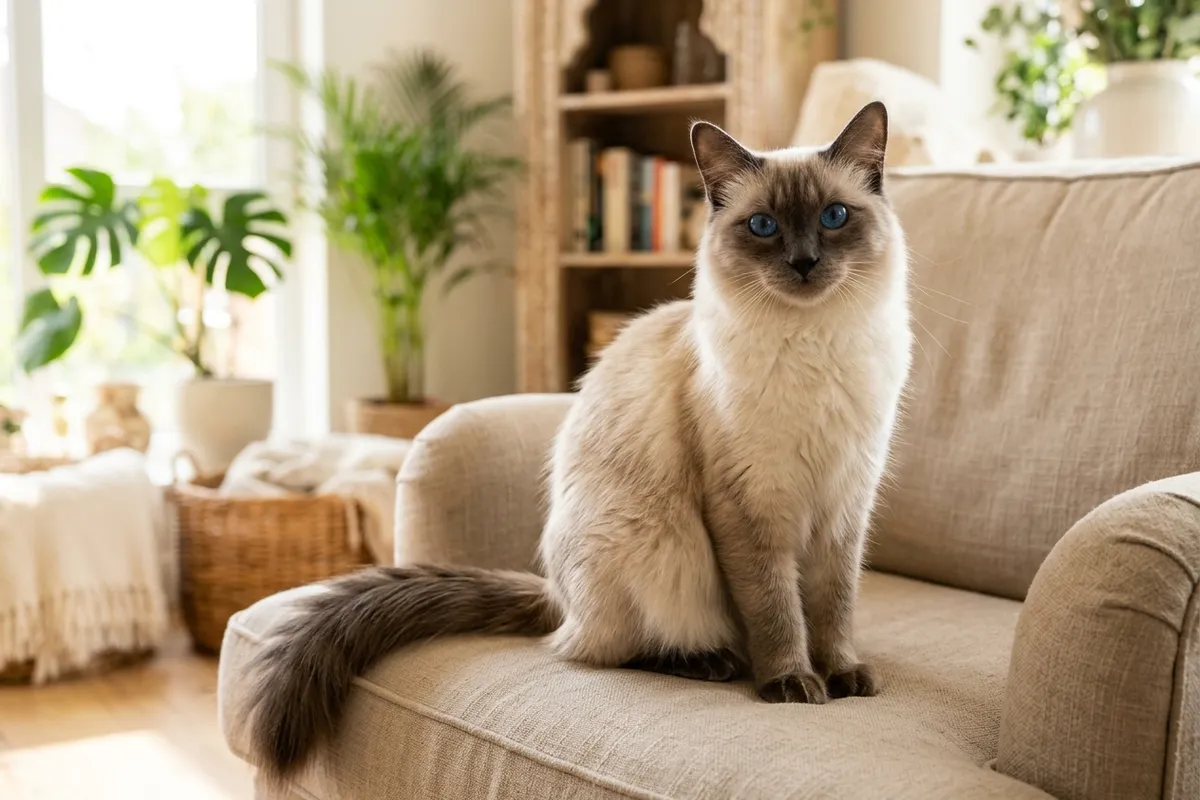
With its slender, aristocratic silhouette, mesmerizing sapphire-blue eyes, and a luxuriant, feathery plume tail, the Balinese cat enchants anyone who appreciates feline grace. Often affectionately described as the "semi-longhaired Siamese," this breed did not originate on the Indonesian island of Bali as its poetic name suggests, but arose from spontaneous genetic mutations in American catteries during the 1940s. Beyond its regal beauty and affectionate, conversational personality, the Balinese holds a celebrated place in veterinary allergology as one of the natural feline breeds producing significantly reduced levels of the Fel d 1 protein, making it remarkably well-tolerated by allergy sufferers.
In this guide
1. Origins and History: The Silky Longhaired Sibling of the Siamese
Throughout the early 20th century, British and American breeders of purebred Siamese cats occasionally witnessed longhaired kittens in their litters. For decades, these unusual kittens were classified as undesirable genetic flaws and placed in pet homes without registration.
However, in the mid-1940s, two visionary American breeders—Marion Dorsey in California and Helen Smith in New York—recognized the unique aesthetic harmony of these cats and initiated a formal selective breeding program. Helen Smith proposed the name Balinese, believing the cat's supple movements, elongated lines, and plumed tail echoed the poise and grace of traditional Balinese dancers.
The breed was officially recognized by the Cat Fanciers' Association (CFA) in 1970 and by The International Cat Association (TICA) in 1979, cementing its status as one of the most refined oriental breeds in the cat fancy.
---
2. Physical Characteristics and Breed Standard
The Balinese displays the lean, tubular oriental conformation of the modern Siamese, cloaked in a flowing silk coat that softens its geometric angles:
```
┌─────────────────────────────────────────────────────────────┐
│ BALINESE BREED MORPHOLOGY STANDARD: │
│ │
│ • BODY: Tubular, elongated, slender, yet firmly muscled │
│ • HEAD: Tapering wedge from nose to outer ear tips │
│ • EYES: Almond-shaped, slanted, vivid deep sapphire blue │
│ • EARS: Strikingly large, broad at the base, continuing wed│
│ • TAIL: Long, slender, ending in a magnificent silk plume │
│ • COAT: Semi-long, fine, silky, strictly WITHOUT UNDERCOAT │
│ • WEIGHT: Females 2.5 - 3.5 kg | Males 3.5 - 5 kg │
└─────────────────────────────────────────────────────────────┘
```
Colorpoint Pattern
The Balinese exhibits classic temperature-dependent albinism (colorpoint), where melanin concentrates on the cooler peripheral extremities (facial mask, ears, legs, and plume tail) while the body remains pale:
- Seal Point: Deep seal-brown points contrasting with a warm pale fawn torso.
- Blue Point: Slate blue-grey points on a cool, glacial-white body.
- Chocolate Point: Warm milk-chocolate points against an ivory background.
- Lilac Point: Frosty pink-toned grey points on an ethereal magnolia-white coat.
(In North American registries such as CFA, lynx point and red/cream varieties are registered as the Javanese, whereas European registries classify them as Balinese).
---
3. The Hypoallergenic Science: Why the Balinese Causes Fewer Allergies
Many people assume longhaired cats trigger worse allergic reactions than shorthaired breeds. Veterinary molecular research disproves this assumption regarding the Balinese:
```
[Salivary and Sebaceous Glands] ──> [Fel d 1 Protein Synthesis]
│
┌────────────────────────────────────────────┴────────────────────────────────────────────┐
▼ ▼
Domestic Shorthair / Persian Balinese Cat
High baseline Fel d 1 secretion + Dense undercoat Genetic low Fel d 1 production
Heavy dander shed into air → Triggers histamine cascades No woolly undercoat + Minimal shedding → High tolerance
```
- Lower Baseline Fel d 1 Secretion: Clinical studies demonstrate that cats of Balinese and Siberian lineages naturally produce significantly lower quantities of the Fel d 1 allergen in their saliva and sebaceous glands than standard feline populations.
- Single-Layer Coat (No Woolly Undercoat): Dander (dead skin cells coated in dried saliva during grooming) is not trapped inside a dense sub-layer of fur. With virtually no seasonal shedding, airborne dander distribution throughout the home is kept to an absolute minimum.
To compare tolerance levels across other breeds, review our guide to hypoallergenic cat breeds.
---
4. Personality and Temperamento: The Affectionate "Velcro Cat"
If you desire an aloof, quiet cat that sleeps in isolation for 18 hours a day, the Balinese is not the right breed for your home:
- Melodic Vocalization: True to their Siamese ancestry, Balinese cats love to converse. They greet you at the door, narrating their day in a soft, melodic voice that is notably gentler and less piercing than that of shorthaired Siamese cats.
- Extreme Social Attachment: The Balinese thrives on human companionship. They curl in your lap while you work, drape themselves across your shoulders like a warm stole while you cook, and burrow beneath the duvet at night.
- Circus-Level Agility: Long, spring-loaded hind legs allow them to leap effortlessly to the top of open doors and tall bookcases. They require tall vertical cat trees and scratching towers.
- High Trainability: Highly intelligent and eager to interact, many Balinese learn to fetch thrown toys, solve food puzzles, and walk comfortably on a harness and leash.
---
5. Grooming, Environmental Enrichment, and Nutrition
Coat Care
Despite their glamorous appearance, the Balinese coat is among the lowest-maintenance semi-longhair coats in the feline kingdom:
- Brushing Frequency: A gentle weekly brushing with a fine-toothed stainless steel comb easily removes loose hairs and distributes natural skin oils.
- Bathing: Rarely necessary unless the cat gets into something sticky or dirty.
Mental Stimulation and Preventing Boredom
Because of their active minds, prolonged isolation can cause destructive chewing or distress vocalizations. Provide interactive puzzle feeders and engage in 15-minute daily feather-wand play sessions. Learn more calming enrichment strategies in our guide to cat stress and anxiety.
Species-Appropriate Diet
Balinese cats maintain a brisk metabolic rate and a slender frame that should not carry excess adipose tissue. Feed a high-protein, moisture-rich diet combining grain-free wet foods with a balanced BARF raw feeding diet.
---
6. Health, Veterinary Screening, and Lifespan
The Balinese is a robust, long-lived cat, frequently celebrating 15 to 20 years of life under attentive veterinary care. Nonetheless, sharing a gene pool with oriental breeds creates predispositions worth monitoring:
- Progressive Retinal Atrophy (PRA): Inherited photoreceptor degeneration causing night blindness and eventual vision loss. Reputable breeders perform DNA tests on breeding stock.
- Hepatic and Renal Amyloidosis: Abnormal protein deposits in liver or kidney tissue that may impair organ filtration later in life. Annual blood chemistry and urinalysis panels are vital; learn more in our guide on chronic kidney disease in cats.
- Congenital Strabismus (Crossed Eyes): Historically common in Siamese breeds, selective breeding has made this rare, and when present it does not affect quality of life.
- Dilated Cardiomyopathy (DCM) / HCM: Periodic preventive echocardiograms starting at 4 or 5 years of age help safeguard cardiac health.
---
Frequently asked questions
Are Balinese cats good with dogs and children?
Yes, remarkably so. Their confident, playful nature makes them outstanding companions for gentle children, and they integrate easily with cat-friendly dogs that respect their personal boundaries.
Can a Balinese be left home alone during work hours?
Leaving a Balinese alone for more than 8 hours daily is not recommended. They are prone to separation anxiety and depression without companionship. If you work long hours away from home, consider adopting a bonded pair.
What is the precise difference between a Balinese and a Siamese?
The only primary structural genetic distinction is fur length: the Balinese carries two copies of the recessive longhair gene (l/l). In anatomy, temperament, and colorpoint distribution, they are identical. ---
Caring for a cat? Keep their health in your pocket
Register your cat on Nekolife to track vaccination history, weight, and get advice from loving cat parents.
- Vaccine & weight records
- Supportive cat community
- Earn Meow Points & badges
Related pages
Sources
Know someone who needs this?