Feeding Neutered Cats: Portion Control, Satiety and Urinary Prevention
Spaying or neutering is a vital veterinary procedure that significantly extends feline life expectancy while preventing reproductive cancers and territorial roaming. However, within 48 to 72 hours following gonadectomy, feline physiology undergoes a dramatic metabolic shift: while daily energy requirements decline sharply, voluntary appetite increases.
In this guide
1. Hormonal Shifts: Why Neutered Cats Gain Weight Rapidly
Gonadectomy triggers profound neuroendocrine changes in feline energy homeostasis:
- Drop in basal metabolic rate: The loss of gonadal sex hormones (estrogen in females, testosterone in males) reduces resting energy expenditure by 25% to 33% (Root et al.). The animal requires substantially fewer daily calories to maintain vital physiological processes.
- Disrupted satiety signaling and ghrelin: Estrogens naturally exert an anorexigenic (appetite-suppressing) effect on the feline hypothalamus. Once removed, circulating ghrelin (the hunger hormone) increases, prompting frequent food-seeking behaviors.
- Decreased voluntary activity: Without mating behaviors and territorial patrols, physical calorie expenditure drops by 40% to 50%.
When owners allow free-choice (ad libitum) feeding, neutered cats gain significant fat mass within months, overloading joints and quadrupling the risk of developing type 2 diabetes mellitus.
---
2. Urinary Vulnerability: Crystals and FLUTD
Weight gain and gonadectomy are closely linked to feline lower urinary tract disease (FLUTD).
Key pathophysiology factors promoting urolithiasis in neutered cats include:
- Infrequent voiding: Sedentary cats spend hours resting between litter box visits, causing prolonged urine retention in the bladder.
- High solute concentration: Concentrated urine allows mineral salts to supersaturate and precipitate onto cellular debris.
- Urine pH instability: Inappropriate diets destabilize urine pH: values above 6.8 foster struvite (magnesium ammonium phosphate) crystals, whereas values below 6.0 in dehydrated cats promote calcium oxalate precipitation.
If your neutered cat strains painfully in the litter box, produces only small droplets, or cries when urinating, seek urgent care immediately at Emergency veterinarians near you.
---
3. Calculating Daily Caloric Requirements (MER)
To maintain ideal body condition or support safe weight loss, veterinary clinical nutritionists apply the Maintenance Energy Requirement (MER) equation:
- Calculate Resting Energy Requirement (RER):
```
RER (kcal/day) = 70 × (Ideal body weight in kg)^0.75
```
(For an ideal 4 kg cat: RER = 70 × 2.82 ≈ 197 kcal/day).
- Adjust for neutered status:
- Standard maintenance for neutered cat: `MER = 1.2 × RER` (~236 kcal/day for 4 kg).
- Sedentary neutered cat or prone to weight gain: `MER = 1.0 × RER` (~197 kcal/day for 4 kg).
- Structured weight loss (obesity): `MER = 0.8 × RER` (~158 kcal/day for 4 kg).
Check the caloric density (kcal/kg) listed on your cat food packaging to convert daily calories into precise grams. Always weigh food with a digital scale—plastic measuring cups can overfeed by 20 to 25 grams per day, adding half a kilogram of body fat in a single year.
---
4. Dietary Strategy: High Protein, Satiety Fiber & 50% Wet Food
An optimal diet for neutered felines rests on four nutritional pillars:
| Nutritional Parameter | Ideal Dry Matter Target | Clinical Veterinary Purpose |
|---|---|---|
| High biological value protein | > 38% - 45% | Preserves lean muscle mass during caloric restriction |
| Moderate dietary fat | 10% - 13% | Strictly limits calorie density per gram |
| Dietary fiber (Psyllium / Cellulose) | 6% - 9% | Expands with gastric water, promoting prolonged satiety |
| Controlled Phosphorus and Magnesium | P < 0.8%, Mg < 0.08% | Prevents mineral supersaturation and urinary stones |
The Essential Role of Mixed Wet Feeding:
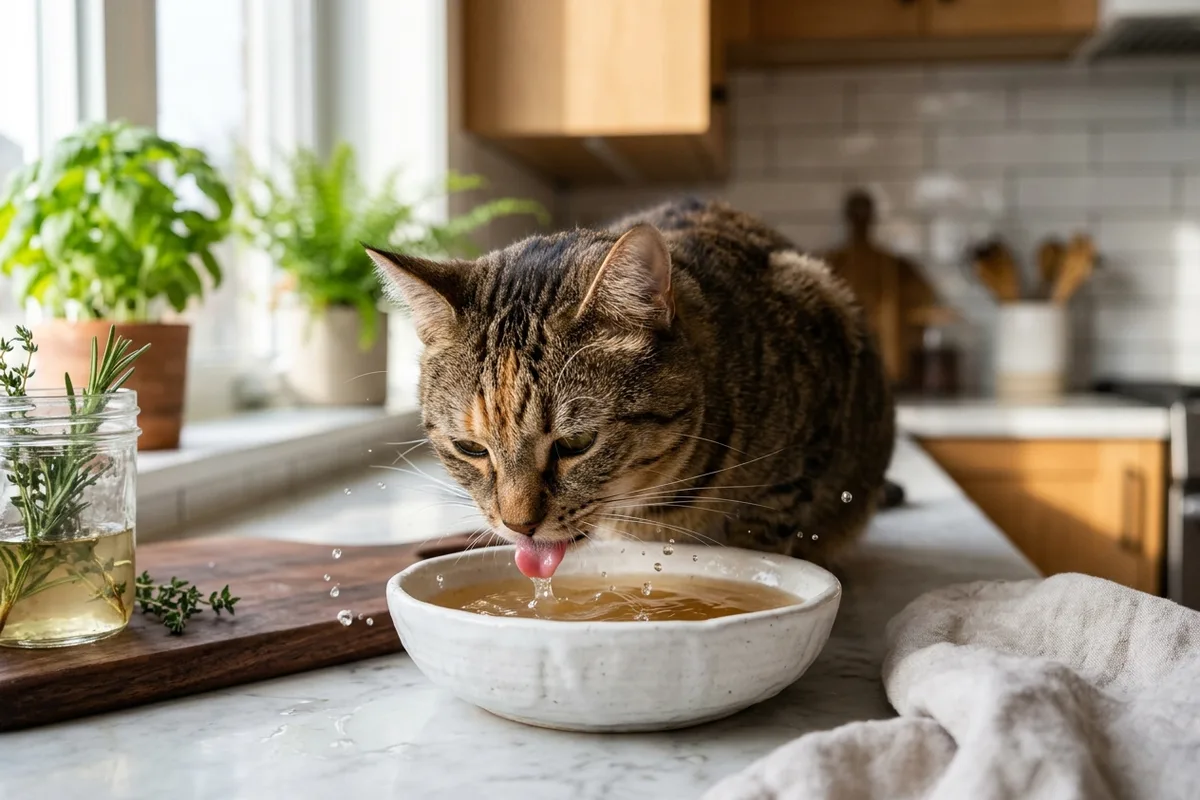
Supplying half of your cat's daily caloric allotment via complete wet food triples daily water intake. This keeps urine specific gravity below 1.035, diluting minerals and physically preventing crystal nucleation.
---
Sources & Scientific References
- Root, M. V., Johnston, S. D., & Olson, P. N. (1996): Effect of prepuberal and postpuberal gonadectomy on heat production and weight gain in domestic cats, American Journal of Veterinary Research, 57(3), 371-374.
- Harper, E. J., Stack, K. E., Watson, T. D., & Moxham, G. (2001): Effects of growth and neutering on energy expenditure in cats, Journal of Feline Medicine and Surgery, 3(1), 25-28.
- WSAVA Global Nutrition Committee (2020): Calorie Needs and Nutritional Assessment Guidelines for Neutered Felines.
- Lund, E. M., Armstrong, P. J., Kirk, C. A., & Klausner, J. S. (2005): Prevalence and risk factors for obesity in adult cats from private US veterinary practices, International Journal of Applied Research in Veterinary Medicine, 3(2), 88-96.
Caring for a cat? Keep their health in your pocket
Register your cat on Nekolife to track vaccination history, weight, and get advice from loving cat parents.
- Vaccine & weight records
- Supportive cat community
- Earn Meow Points & badges
Related pages

Know someone who needs this?