How to Trim Cat Nails: Safe Technique, Quick Anatomy, and No Fear
For many feline guardians, nail trimming day is dreaded as an exhausting wrestling match involving hisses, flying towels, and accidental scratches. Yet cat claws are sophisticated anatomical tools: retractable hunting and climbing structures made of hard, translucent keratin protecting a sensitive, blood-rich core. By understanding claw anatomy and adopting a gradual desensitization technique with positive reinforcement, clipping your cat's claws transforms into a calm, two-minute grooming routine that causes zero pain and zero drama.
In this guide
1. Anatomy of the feline claw: Where is the quick?
Feline claws are not dead fingernails; they are the distal phalangeal bone of each toe, operated by an elastic extensor ligament that keeps them safely retracted inside a protective sheath when walking.
```
┌───────────────────────┐
│ FELINE CLAW ANATOMY │
└───────────┬───────────┘
│
┌─────────────────┴─────────────────┐
▼ ▼
[ THE QUICK (Living Core) ] [ DEAD TIP (Keratin) ]
- Pink central triangle - Clear translucent curve
- Blood vessel and nerve endings - No sensation
- NEVER CUT HERE! - ✅ SAFE CUT ZONE (1-2 mm tip)
```
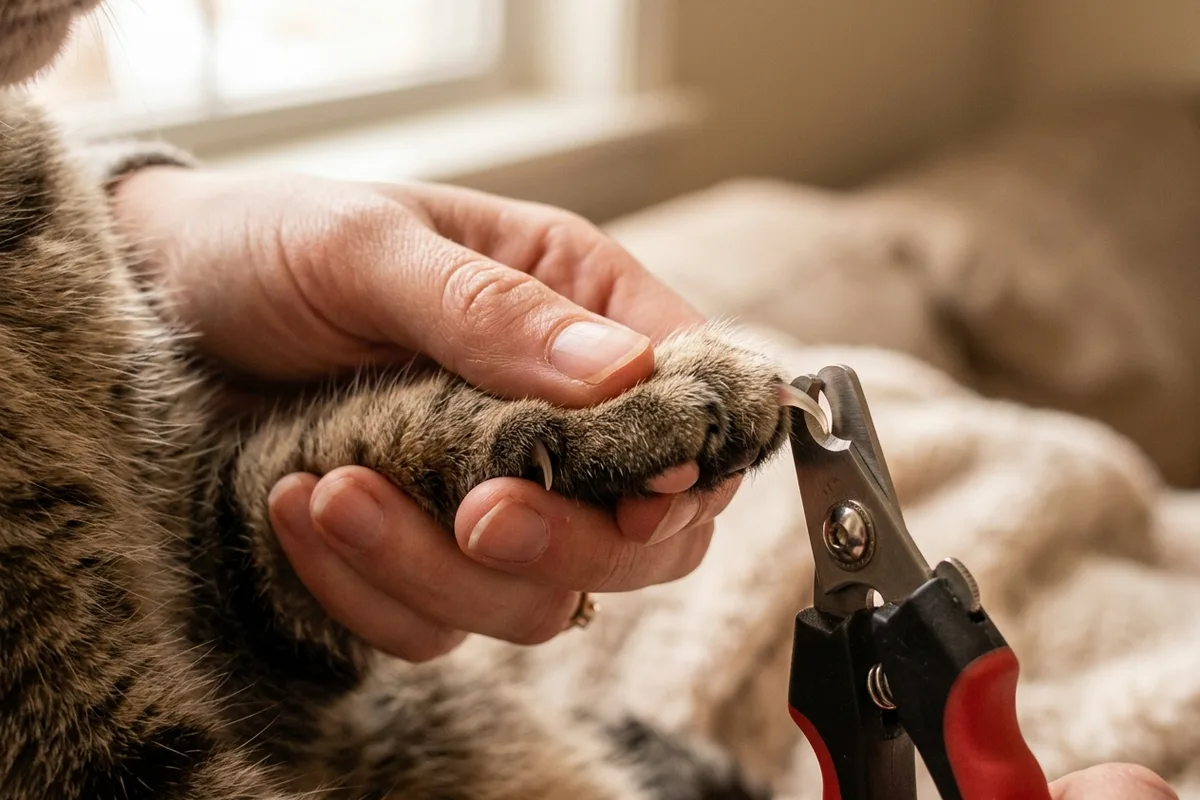
Gently pressing the top and bottom of the paw pad pushes the claw forward into plain view:
* The quick (pink zone): The vascular matrix supplying blood and sensation to the claw. Cutting here causes sharp pain and immediate bleeding.
* The translucent tip (corneal zone): Dead, compacted keratin with no nerve endings. This is the only part that needs to be removed.
* Dark or black claws: If your cat has pigmented claws, inspect from underneath with a phone flashlight, or trim strictly the razor-sharp hook of the claw.
---
2. How often should cat claws be trimmed?
Trimming needs vary based on age, mobility, and lifestyle:
| Cat Profile | Recommended Frequency | Veterinary Reason |
|---|---|---|
| Indoor cats | Every 2 – 3 weeks | Even with scratching posts, scratching only sheds outer husks while sharpening the tip. |
| Senior cats (> 10 years) | Every 1 – 2 weeks | Arthritis reduces grooming and movement. Claws thicken and easily curl into footpads. |
| Young kittens (< 6 months) | Every 10 – 14 days | Need frequent trims to prevent needle-sharp scratches and learn positive kitten care habits. |
| Outdoor cats | As needed / rarely | Claws are essential for tree climbing and escaping predators. Only clip tips if catching on carpets. |
---
3. Essential grooming tools
- Scissor-style cat clippers: The half-moon indentation securely cups the claw, slicing crisply without splintering.
- Styptic powder or cornstarch: Keep an open container of styptic powder (Kwik Stop) or plain kitchen cornstarch nearby.
- High-value rewards: Churu lickable treats, squeeze cheese, or cooked chicken given solely during paw handling.
- Soft bath towel: For gentle swaddling if your cat tends to paddle with back paws.
> [!CAUTION]
> Avoid human nail clippers and kitchen scissors: Their flat blades exert horizontal pressure that crushes the round cylinder of cat claws, splitting the keratin up to the quick.
---
4. Step-by-step technique: Stress-free cooperative care
Phase 1: Desensitization (Days 1–3)
Do not bring out clippers on day one. During calm evening cuddle sessions:
* Gently stroke paws and touch toe pads.
* Press a pad to extend a claw, offer a lick of treat, and immediately let go.
* Click the clippers near your cat while they enjoy a snack so the sound creates no alarm.
Phase 2: Ergonomic positioning
Sit on the floor or sofa with your cat resting on your lap facing forward, looking in the same direction you are. This gives you comfortable control without confrontational face-to-face pinning. If your cat is squirmy, wrap them gently in a towel like a burrito, leaving only one front leg exposed to manage stress and anxiety.
Phase 3: The cut
- Hold the paw gently but securely between thumb and forefinger.
- Lightly press the pad to expose the claw.
- Align clippers at a 45-degree angle, following the downward curve of the nail.
- Snip crisply, maintaining at least a 2 mm buffer from the pink quick.
- If your cat allows only one or two claws before fidgeting, stop there. Reward enthusiastically and do the rest tomorrow.
---
5. What to do if you clip the quick and it bleeds
If your cat twitches unexpectedly and you nick the quick, do not panic:
- Stay calm and quiet: Shouting or gasping scares the cat, causing them to bolt and track blood.
- Apply direct styptic powder: Dip the bleeding claw tip directly into styptic powder (or cornstarch) and apply steady pressure with a clean tissue for 30 to 60 seconds.
- Keep the cat calm for 2 minutes: Hold your cat on your lap and feed a treat to prevent licking while the platelet plug hardens.
- Seek veterinary advice if bleeding continues after 10 minutes: Prolonged bleeding may require professional cautery or a temporary pressure wrap.
---
6. Frequently asked questions (FAQ)
Why do cats hate having their paws touched?
Cats' paw pads contain dense sensory mechanoreceptors and proprioceptors essential for stealth stalking and balance. Being held by the paws triggers an instinctive vulnerability reflex.
Do back claws need to be trimmed as often as front claws?
No. Back claws naturally wear down as cats push off to leap and sprint, so they grow slower and remain blunter. Checking them once a month is usually sufficient.
Does clipping claws stop furniture scratching?
Clipping dulls the sharp hook, significantly reducing damage to upholstery, but cats still need to scratch to mark territory with paw pheromones and stretch their backs. Provide sturdy scratching posts and scratchers.
What is declawing (onychectomy) and why is it banned?
Declawing is not a nail trim—it is surgical amputation of the last toe bone (equivalent to cutting human fingers off at the last knuckle). It causes permanent chronic neuropathic pain, behavioral issues, and biting. It is illegal in most countries and strongly condemned by all major veterinary associations worldwide.
---
Sources and veterinary literature
- American Association of Feline Practitioners (AAFP): Feline Behavior Guidelines: Nail Trimming and Cooperative Veterinary Care.
- International Society of Feline Medicine (ISFM): Cat Friendly Clinic Protocols: Gentle Handling & Stress Reduction in Grooming.
- World Small Animal Veterinary Association (WSAVA): Position Statement on Feline Onychectomy (Declawing).
- Cornell University College of Veterinary Medicine: Step-by-step trimming your cat's claws safely.
Caring for a cat? Keep their health in your pocket
Register your cat on Nekolife to track vaccination history, weight, and get advice from loving cat parents.
- Vaccine & weight records
- Supportive cat community
- Earn Meow Points & badges
Related pages
Know someone who needs this?