Neutering your cat: at what age, care, and recovery
Today it is recommended to neuter or spay cats around 4 months of age, before they can reproduce. Most go home the same day and by the next day are back to normal.

Quick answers
- At what age?Around 4 months, and before 5 according to the American Association of Feline Practitioners (AAFP).
See age for neutering ↓ - Before or after the first heat?Before.
See first heat ↓ - Can it be done in heat?In queens, yes: the surgery can be done during heat.
See neutering in heat ↓ - What if she is pregnant?Spaying interrupts the pregnancy. You decide with your vet.
See spaying while pregnant ↓ - After giving birth?We did not find a fixed timeline in veterinary sources: your vet decides the timing.
See after giving birth ↓ - When to go back to the vet after surgery?If they are very lethargic, lick the wound a lot, or the wound is red or swollen.
See signs ↓
In this guide
At what age is a cat neutered?
Cats can reach sexual maturity from 4 months, although it is usually around 5 or 6. That is why today it is recommended to neuter them around 4 months, before that maturity.
- AAFP: supports neutering cats that will not be bred before 5 months, because they can reproduce from 4 or 5 months without it being obvious.
- Cornell: recommends spaying females and neutering males between 3 and 6 months.
- It used to be common to wait until 6 months, but by that age many cats have already matured.
Is it safe so young? International Cat Care explains that there are no disadvantages to neutering around 4 months and that anesthesia in kittens today carries less risk. Studies of cats followed for up to 3 years afterward found no negative effects, and kittens recover faster.
In very large breeds, talk with your vet about the best timing. In the end, the exact age is decided by them based on your cat’s health.
Before or after the first heat?
Before. Cornell states that a queen should be spayed before her first heat, which usually arrives around 6 months, though it can be earlier.
- Spaying between 3 and 6 months, before mammary tissue develops, practically eliminates her risk of breast cancer.
- International Cat Care also notes a lower risk of certain cancers if she is spayed before 6 months.
Benefits of neutering or spaying
In queens:
- Prevents pyometra, a serious uterine infection.
- Reduces the risk of mammary tumors.
- Prevents other problems of the uterus and ovaries, such as infections, cysts, and cancers.
- Ends heat: without spaying, a queen “calls” about every 3 weeks in the breeding season.
- Avoids unwanted litters: a queen can have up to 3 litters a year.
In males:
- Prevents testicular cancer and almost certainly prostate enlargement.
- Fewer fights, fewer bite abscesses, and less spread of disease to other cats.
- They roam less from home, with less risk of being hit by cars.
- Reduces urine marking, which in intact males has a very strong smell.
Neutering a male vs. spaying a female: what the surgery is like
Both are done under general anesthesia.
Spaying the queen
- An area is shaved and the ovaries and sometimes also the uterus are removed, through the belly or the flank.
- If everything goes well, surgery lasts 15 to 20 minutes.
- She usually goes home the same day, though some clinics prefer to keep her overnight for observation.
- If she has skin stitches, they are removed at 7–10 days.
Neutering the male cat
- Both testicles are removed through a small incision in the scrotum.
- It is quicker and simpler than the female procedure.
- Usually there are no stitches and he goes home the same day.
Before surgery, your vet will tell you from when they should not eat.
Can you spay a queen in heat, pregnant, or after giving birth?
In heat
Yes. Guidelines from the World Small Animal Veterinary Association (WSAVA) state that, unlike bitches, queens can be spayed during heat, because the increased blood supply to their organs is not clinically important.
Pregnant
Spaying (removing ovaries and uterus) prevents or completely interrupts the pregnancy. It is a decision to discuss with your vet, who will assess your queen’s condition.
After giving birth
We did not find a fixed timeline in top-tier veterinary sources for spaying after birth. Talk with your vet about the best timing. Meanwhile, keep her away from intact males: a queen can have up to 3 litters a year.
Care after neutering
- Surgery dayAlmost always they go home the same day. They may arrive a bit sleepy. Keep them indoors.
- The next dayMost are already normal. Reduce their activity for as long as the vet advises.
- First weekFor queens, Cornell advises watching her and keeping her as calm as possible for a week, so the belly wound does not open.
- At 7–10 daysIf there are skin stitches, they are removed.
- At two weeksThey are usually the same as before the operation.
First days at home
- Give them a quiet place to rest.
- Keep them indoors with little activity for as long as your vet says.
- If you are given painkillers, use only those. Never give aspirin, ibuprofen, or paracetamol without veterinary approval: they can be toxic to cats.
The wound and the cone or surgical shirt
- Check the wound every day.
- If they lick or scratch the wound a lot, tell your vet.
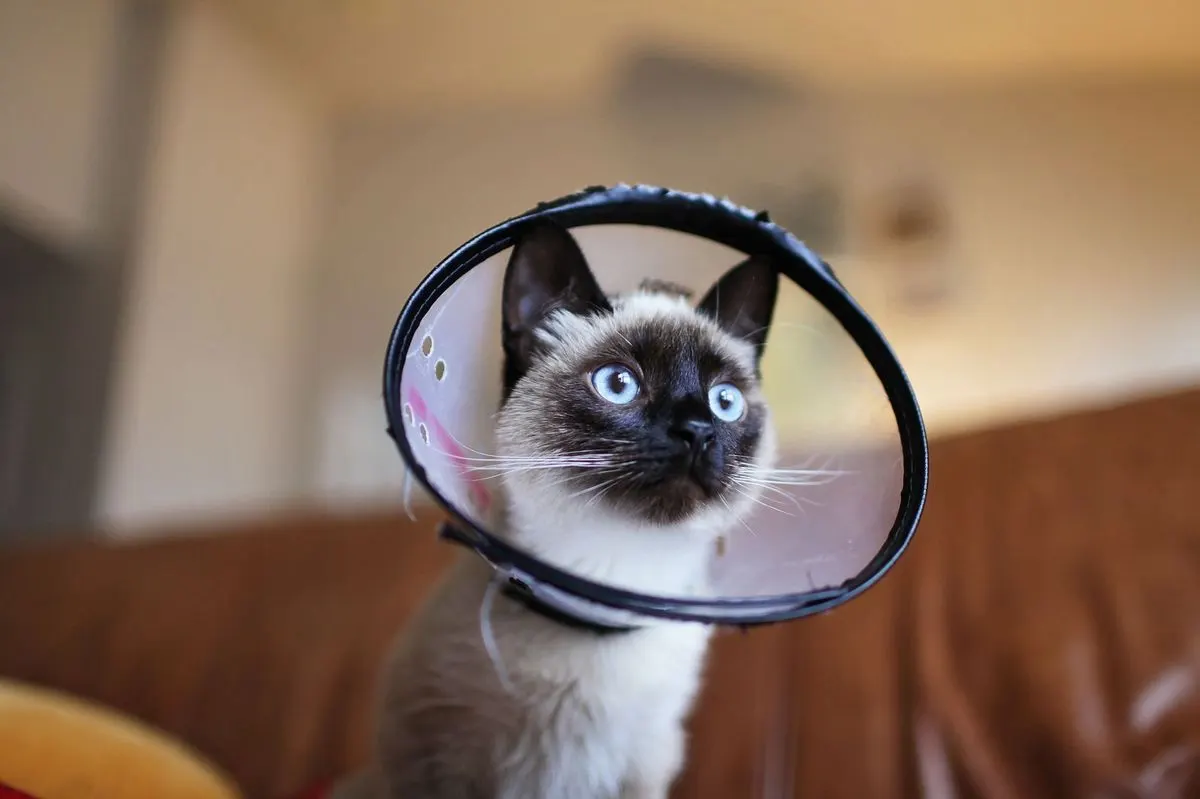
- Your vet may recommend an Elizabethan collar (cone / e-collar) or a post-surgical shirt so they don’t lick. Use it as your vet advises.
- The shaved fur grows back. In Siamese cats it may come in darker for a while.
Signs to go back to the vet
Call your vet if:
- They are unusually quiet or lethargic.
- They lick or scratch the wound a lot.
- The wound is red or swollen.
Does anything change afterward? Weight, food, and behavior
Weight and food. Neutered cats tend to gain weight more easily. Watch their weight and adjust food if needed. We cover this in What cats eat.
Behavior. By about two weeks they are usually the same as before, just without reproductive organs. What does change:
- They fight less with other cats.
- They roam less from home.
- Heat disappears in queens.
- Urine marking decreases, though it does not always disappear, because hormones are not its only cause.

Free or low-cost neutering
In many cities there are free or low-cost neutering campaigns run by municipalities or shelters. Ask your local government or nearby shelters, and check Vets near you.
Wherever you go, ask how anesthesia will work, what aftercare is needed, and whom to call if something is wrong.
Myths about neutering
- “It’s better if she has one litter first.” False. It is not necessary and brings the queen no benefit.
- “She’s still too young to get pregnant.” A queen can get pregnant from 4 months.
- “It’s dangerous to operate so young.” Anesthesia in kittens today carries less risk, and complications are no more frequent than in older cats.
- “If he’s a male, it’s not needed.” One intact male is enough to impregnate many queens in the area.
- “It changes their personality.” In about two weeks they are usually the same as before.
Frequently asked questions
At what age can a cat be neutered?
Around 4 months, before sexual maturity. The AAFP recommends doing it before 5 months.
Can you spay a queen in heat?
Yes. According to WSAVA guidelines, queens can be spayed during heat.
Is it better to neuter before or after the first heat?
Before: that way the risk of breast cancer almost disappears.
How long does recovery take?
Most are normal the next day. If there are stitches, they are removed at 7–10 days, and by two weeks they are usually the same as before.
What care is needed afterward?
Rest and little activity for as long as the vet advises, keep them indoors, and watch the wound. No human medicines.
Does a neutered cat still mark?
Urine marking decreases, but it does not always disappear.
Do neutered cats gain weight?
They tend to gain weight more easily, so watch their weight and adjust food.
Do they need to have one litter first?
No. Having a litter first brings the queen no benefit.
Caring for a cat? Keep their health in your pocket
Register your cat on Nekolife to track vaccination history, weight, and get advice from loving cat parents.
- Vaccine & weight records
- Supportive cat community
- Earn Meow Points & badges
Related pages
Sources
- "Neutering your cat". International Cat Care (iCatCare). Updated September 26, 2025. icatcare.org
- "Why do I need to neuter my cat?". International Cat Care (iCatCare). Updated September 26, 2025. icatcare.org
- "2020 Pediatric Sterilization in Cats" (position statement). American Association of Feline Practitioners (AAFP). catvets.com
- "Spaying and Neutering". Cornell Feline Health Center, Cornell University College of Veterinary Medicine. vet.cornell.edu
- "Ask Elizabeth: Should I Consider a Pediatric Spay or Neuter?". Cornell Feline Health Center, Cornell University College of Veterinary Medicine. vet.cornell.edu
- Romagnoli, S. et al. "WSAVA guidelines for the control of reproduction in dogs and cats". Journal of Small Animal Practice, 2024. World Small Animal Veterinary Association (WSAVA). wsava.org
- "Prevention or Termination of Pregnancy in Bitches and Queens". Merck Veterinary Manual. Updated June 2025. merckvetmanual.com
Know someone who needs this?