Feline Slow Feeders and Puzzle Feeders: 'Scarf and Barf' Physiology, Designs and Ethology
Many indoor felines consume their entire kibble meal in under a minute, only to regurgitate it undigested onto the rug moments later. This common phenomenon, widely known as the "scarf and barf" cycle, rarely stems from infectious gastritis. Rather, it is the predictable consequence of an evolutionary mismatch between wild feline hunting biology and modern open food bowls.
In this guide
1. "Scarf and Barf" vs. True Vomiting
Caregivers should clearly differentiate these clinical events:
- Rapid Regurgitation (Immediate Postprandial): Occurs 2 to 15 minutes after eating. The expelled material is tubular (conforming to the esophagus), dry, completely intact, and devoid of yellow bile or violent abdominal heaving.
- Active Vomiting: Preceded by visible nausea (hypersalivation, repeated lip-licking, deep abdominal contractions). The expelled fluid contains digested acid chyme and bile.
Slow feeders eliminate regurgitation by preventing aerophagia and giving cholecystokinin (CCK) hormones adequate time to signal neurochemical satiety to the brain.
---
2. Puzzle Feeder Categories
| Design | Mechanics | Best Suited For | Food Consistency |
|---|---|---|---|
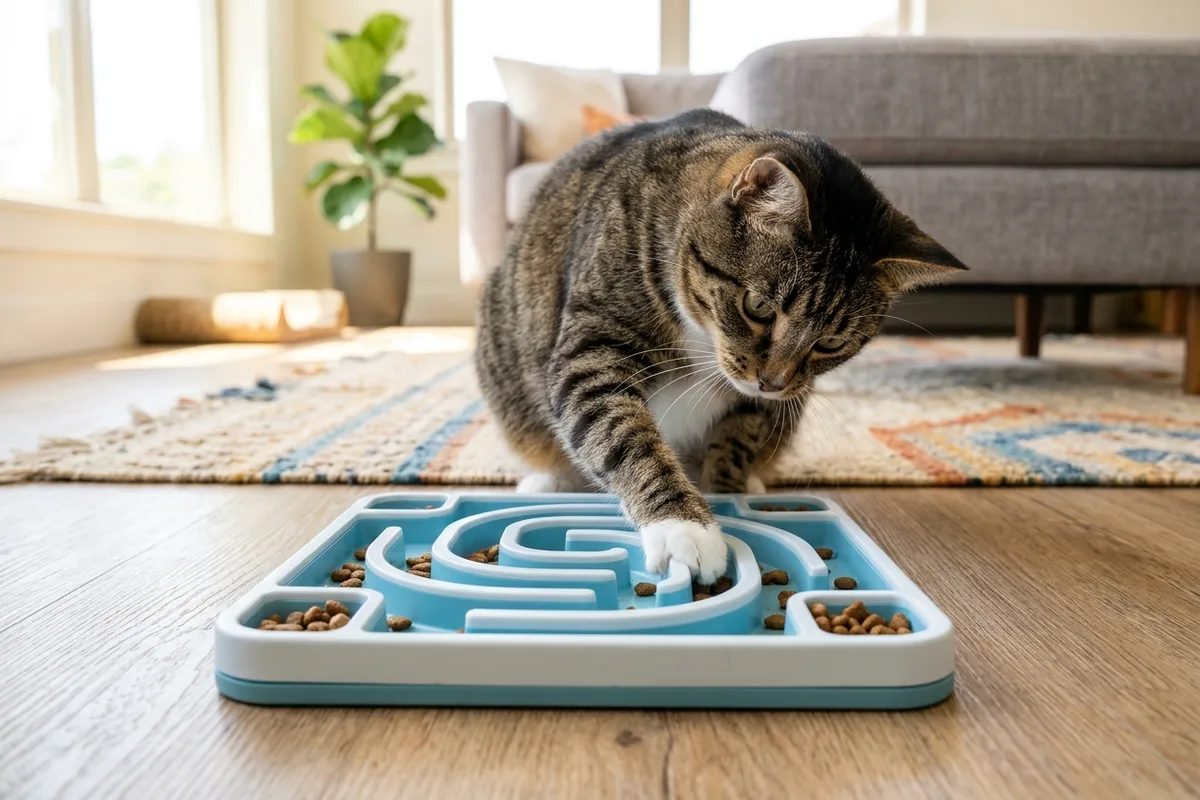
| Maze boards (Fummelbrett) | Cat hooks kibble with claws and pads | Beginners and senior cats | Dry kibble and crunchy treats |
| Vertical Towers & Tubes | Food drops sequentially through chambers | High-energy agile cats | Dry kibble |
| Silicone Lick Mats | Textured grooved surfaces | Calming anxiety, lowering cortisol | Pâtés, purees, chilled broths |
| Rolling Treat Dispensers | Must be pushed across floors | Sedentary and overweight cats | Calibrated dry kibble |
---
3. Preventing Whisker Fatigue (Whisker Stress)
Feline vibrissae are sensitive tactile radar organs innervated by the trigeminal nerve. Deep, narrow puzzle crevices force whiskers against hard plastic boundaries, causing sensory overstimulation and frustration. Always select wide, open designs where paws do the work or shallow contours where whiskers remain untouched.
---
4. Gradual Introduction Protocol
Never switch cold-turkey from a bowl to an advanced puzzle:
- Step 1: Scatter food on the easiest edge compartments where food is immediately reachable.
- Step 2: Split meals half-and-half between the puzzle and the traditional dish.
- Step 3: Transition completely. A meal that previously vanished in 45 seconds will take 15 enjoyable minutes, triggering dopamine release and postprandial relaxation.
---
5. When to Seek Veterinary Care
If your cat continues regurgitating or vomiting daily despite using slow feeders, exhibits painful swallowing, or demonstrates weight loss, rule out megaesophagus or esophageal strictures by visiting our directory of veterinary clinics and emergency hospitals.
---
Scientific Sources & References
- Journal of Feline Medicine and Surgery (2023): Food puzzles for cats: Feeding for physical and emotional wellbeing.
- American Association of Feline Practitioners (AAFP, 2022): Feline environmental needs guidelines and foraging behavior.
- Applied Animal Behaviour Science (2024): Effects of puzzle feeders on feeding rate and stress markers in domestic cats.
Caring for a cat? Keep their health in your pocket
Register your cat on Nekolife to track vaccination history, weight, and get advice from loving cat parents.
- Vaccine & weight records
- Supportive cat community
- Earn Meow Points & badges
Related pages
Know someone who needs this?