Why Cats Bite When Petted: Overstimulation and Feline Ethology Explained
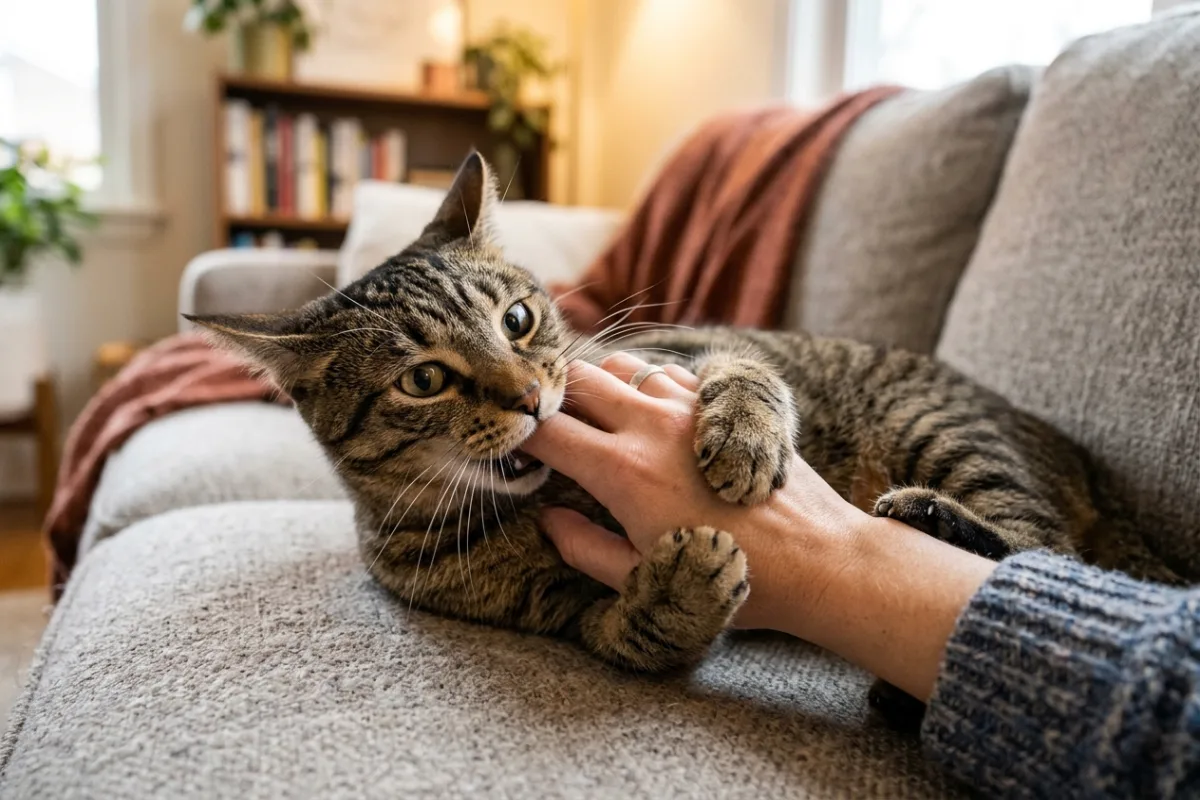
It is one of the most baffling and disheartening experiences for any cat guardian: you are relaxing on the sofa, your cat hops onto your lap, starts purring warmly as you stroke their back, and then, in the blink of an eye, turns around and clamps their teeth onto your hand or delivers a sharp swat. Far from being an act of spite or unpredictable malice, this reaction has a well-documented scientific name in feline behavioral medicine: petting-induced aggression.
In this guide
1. Petting-Induced Aggression: Why Does It Happen?
To understand feline behavior, remember that domestic cats descend from Felis lybica (the African wildcat), a solitary predator that did not evolve for sustained, full-body tactile contact. Unlike pack dogs that relish prolonged petting, a cat's nervous system is primed for lightning-fast vigilance.
Mechanoreceptor overload in feline skin
A cat's epidermis is richly supplied with sensory receptors and nerve endings wrapped around every hair follicle. When stroked repeatedly across their torso:
- Continuous repetitive stroking builds static charges and intense neurological excitement.
- Once the cat's individual tolerance threshold is reached, the pleasurable grooming feeling flips abruptly into pain, tingling, or electrical discomfort.
- The cat experiences motivational ambivalence: they love being close to you, but their nervous system screams to stop the sensory input immediately. Lacking human speech, an inhibitory bite is their most decisive way of declaring "Stop, that is enough!".
---
2. Feline Body Map: Safe Zones vs High-Risk Areas
Different regions of a cat's body process touch very differently. Cats overwhelmingly prefer touch where their scent glands are concentrated:
| Body Area | Tolerance Level | Ethological Explanation |
|---|---|---|
| Chin and base of ears | 🟢 Green Zone (Safest) | Dense facial pheromones; mimics mutual social grooming (allogrooming). |
| Cheeks and lip corners | 🟢 Green Zone (Safest) | Extremely pleasurable; cats actively push their scent glands against your fingers. |
| Crown of the head | 🟢 Green Zone (Safest) | Neutral, calming area between the ears. |
| Back (neck to mid-spine) | 🟡 Yellow Zone (Moderate) | Tolerated with light, brief strokes; quickly overstimulates if stroked firmly or repeatedly. |
| Base of tail (rump) | 🔴 Red Zone (High Risk) | Hyper-innervated erogenous zone; triggers frantic arousal and sudden swatting. |
| Belly and abdomen | ⛔ Forbidden Zone (Danger) | Vulnerable soft organ area. Exposing belly displays trust, NOT an invitation to touch. |
| Paws and pads | 🔴 Red Zone (High Risk) | Vibration sensors and flight tools; grabbing paws induces acute vulnerability. |
> [!TIP]
> The belly trap debunked: When a cat rolls onto their back and displays their tummy, they are signaling: "I trust you enough to let my guard down in your presence". If you reach out to rub their belly like a dog, you violate that vulnerability, instantly engaging four paws and claws in self-defense.
---
3. Pre-Bite Body Language: Unnoticed Warning Signals
Cats virtually never bite without prior warning. In the crucial seconds before teeth touch skin, they display subtle behavioral micro-cues:
- Twitching tail: The tail tip swishes back and forth or lashes rhythmically against the floor.
- Ear orientation: Ears rotate sideways or flatten backward against the skull ("airplane ears").
- Mydriasis (pupil dilation): Pupils suddenly expand to absorb more light amid a surge of adrenaline.
- Abrupt stop in purring: Breathing becomes tense, shallow, or silent.
- Dorsal skin twitching: Visible ripples and muscle twitches travelling along the spine.
- Head swivel: The cat turns their head to track your moving fingers with a tense jaw.
Noticing any single one of these warning signs means you must stop stroking immediately and withdraw your hand.
---
4. What to Do (and NEVER Do) During a Bite
The "Freeze" technique
If you missed the cues and your cat has latched onto your hand:
DO NOT yank your hand away: Pulling back instinctively activates your cat's predatory reflex (prey drive*), prompting them to sink their canine teeth deeper and tear skin.
* Stay completely still: Relax your hand and fingers. When the "prey" stops moving and fighting back, the defensive trigger dissipates, and the cat will release within seconds.
* Push gently inward (counter-intuitive but effective): If the bite is held firmly, nudging your hand slightly deeper into their mouth breaks their jaw leverage and forces them to open their jaws to let go.
Severe mistakes that aggravate the issue
* Never strike, shove, or scream: Physical or verbal punishment teaches your cat that human hands are dangerous and erratic, transforming overstimulation into fear-based defensive aggression.
* Do not use squirt water bottles: Water spraying damages emotional trust and induces chronic territorial anxiety.
---
5. The 3-Second Rule and Consent Testing
The gold standard for positive interactions is testing for ongoing consent:
```mermaid
graph TD
A[Pet gently for 3 seconds on cheek or chin] --> B[Pause and pull hand back 10 cm]
B --> C{What does your cat do?}
C -->|Rubs head against your hand| D[Consent confirmed: Pet for another 3 seconds]
C -->|Looks away or remains still| E[Session ended: Respect their boundary]
C -->|Twitches tail or walks away| E
```
- Let the cat initiate: Wait for your cat to approach you and rub their cheeks against your hands or legs.
- Stroke for 3 seconds only: Stick to safe green zones (cheeks and chin).
- Pause and assess: Pull back slightly. If your cat nudges your fingers with their nose, they are actively requesting more. If they look away, lick their lips, or remain still, conclude the petting session on a peaceful note.
---
6. When to Consult a Veterinarian
If your cat previously enjoyed gentle petting and suddenly develops aggressive touch aversion, underlying medical pain must be ruled out immediately:
* Feline osteoarthritis and spinal pain: Common in cats over 7 years old. Touching the lower back, hips, or tail base triggers acute joint inflammation pain.
* Dental disease: Gingivitis, stomatitis, or feline tooth resorption (TR) causing severe discomfort when jaws are touched.
* Feline Hyperesthesia Syndrome: A neurological condition causing intense spinal sensitivity, skin rippling, and self-directed or human-directed aggression.
* Dermatitis and flea allergy: Irritated, itchy skin that turns hyper-reactive to human touch.
---
Veterinary References and Sources
American Association of Feline Practitioners (AAFP): Feline Behavior Guidelines: Understanding and Managing Feline Aggression* (2024).
International Society of Feline Medicine (ISFM): Guidelines on Feline Environmental Needs and Positive Human-Cat Interactions* (Journal of Feline Medicine and Surgery).
Beaver, Bonnie V.: Feline Behavior: A Guide for Veterinarians* (Saunders / Elsevier).
Heath, Sarah: Behavioural Problems in Small Animals: A Practical Guide* (Veterinary Clinics of North America).
Frequently asked questions
Are "love bites" different from aggressive bites?
Yes. Gentle nibbles accompanied by purring and mutual licking often mirror feline social grooming. However, even friendly nibbling can rapidly escalate into full overstimulation if contact continues uninterrupted. It is best to gently disengage whenever teeth touch skin.
Why does my cat ambush and bite my ankles when I walk?
Ankle biting is usually redirected predatory play, not petting aggression. It is frequent in energetic, indoor kittens lacking mental stimulation. Schedule two 15-minute daily sessions with wand toys to satisfy their hunting instincts on appropriate targets.
Will neutering or spaying stop petting bites?
Sterilization reduces hormonal roaming and territorial fighting, but it does not change dermal nerve sensitivity or sensory overstimulation thresholds, which are purely neurological. ---
Caring for a cat? Keep their health in your pocket
Register your cat on Nekolife to track vaccination history, weight, and get advice from loving cat parents.
- Vaccine & weight records
- Supportive cat community
- Earn Meow Points & badges
Related pages
Know someone who needs this?