Norwegian Forest Cat: Complete Guide to Traits, Care, and Health
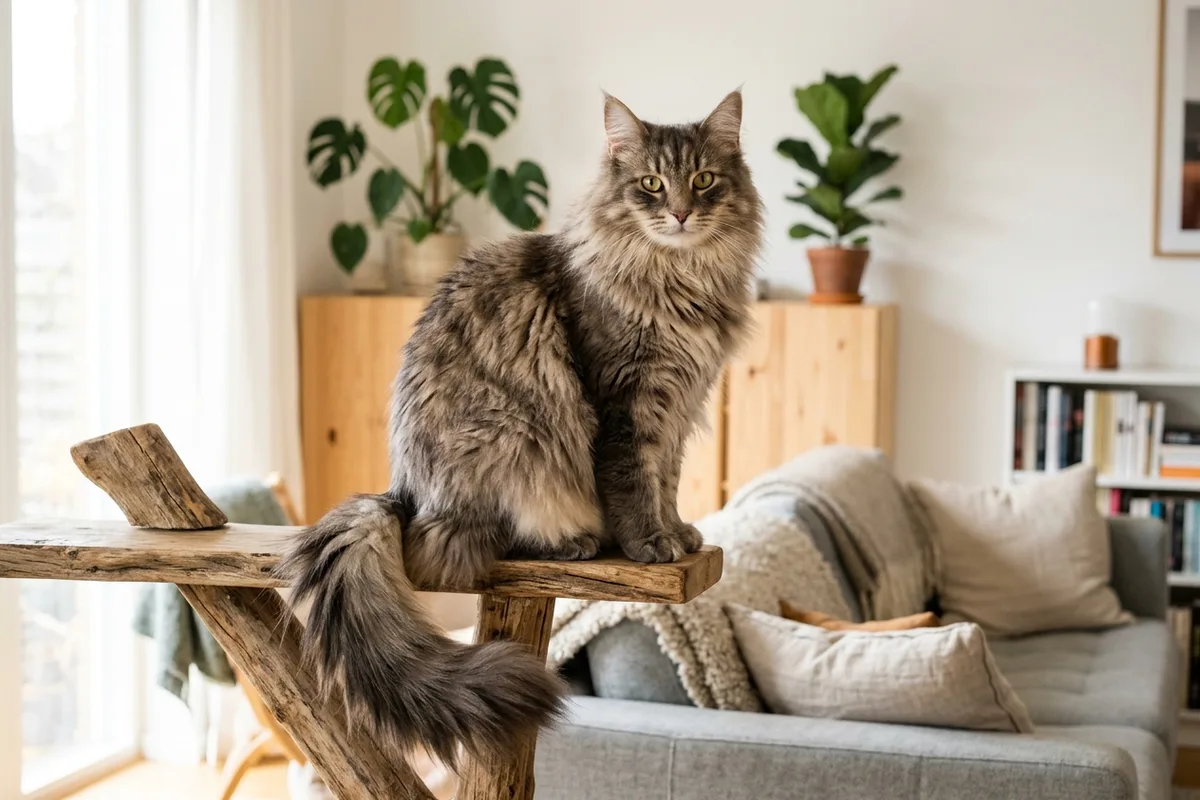
Known in its homeland as the Norsk Skogkatt, the Norwegian Forest Cat is one of the world's most captivating, robust, and regal natural cat breeds. Forged over centuries by the freezing winters of Scandinavia and celebrated in Norse mythology, this majestic feline combines the wild appearance of a subarctic lynx with a remarkably gentle, even-tempered, and devoted personality.
In this guide
Legendary origins and natural evolution
Unlike many modern feline breeds created through intentional crossbreeding programs, the Norwegian Forest Cat is an authentic landrace. Its distinctive anatomy is the direct result of biological adaptation to the subarctic Scandinavian wilderness.
In ancient Norse mythology, two giant, bushy-tailed cats pulled the chariot of Freyja, the goddess of love, beauty, and fertility. Viking folklore also speaks of the huldrekatt ("forest fairy cat"), a wild-looking forest dweller that Norse seafarers welcomed aboard their longships and drakkars to safeguard precious stores of grain from rodents.
By the early 20th century, the breed faced near extinction through crossbreeding with free-roaming domestic short-haired cats. In the 1930s, dedicated Norwegian fanciers formed clubs to preserve the breed, culminating in King Olav V of Norway officially designating the Norsk Skogkatt as the National Cat of Norway in the 1970s. The breed gained formal championship recognition from the Fédération Internationale Féline (FIFe) in 1977.
Physical characteristics of the Norwegian Forest Cat
Every facet of the breed's body reflects evolutionary perfection for surviving subzero Nordic winters:
1. Skeletal frame and proportions
- Body: Substantial, muscular, and medium-to-large, with broad shoulders, deep chest, and heavy bone density.
- Legs: Strong and tall. The hind legs are visibly longer than the forelegs, tilting the rump slightly upward and providing astonishing leaping power.
- Paws: Large and rounded, equipped with generous tufts of hair between the toes that act as snowshoes, preventing ice balling and maximizing snow traction.
2. Head and expression
- Shape: An equilateral triangle, measured from the outer base of the ears down to the chin.
- Profile: Completely straight from the forehead down to the tip of the nose, with zero indentation, concave dip, or nasal break (stop).
- Eyes: Large, almond-shaped, set slightly oblique, giving the cat a keen, wild, and intelligent expression.
- Ears: Medium to large, set wide at the base, adorned with distinctive lynx-like tips and heavy interior protective tufts.
3. The waterproof double coat
The fur of the "Wegie" is an evolutionary masterpiece:
- Dense woolly undercoat: Traps insulating air pockets against the skin to preserve body heat.
- Water-repellent guard coat: Semi-long, smooth, slightly oily guard hairs that shed rain and melted snow like a raincoat.
- Ruff and britches: Features an opulent neck ruff framing the chest and full, fluffy "knickerbockers" on the back thighs.
- Plumed tail: Long and bushy (reaching at least to the shoulder blades), which the cat wraps around its body and face when sleeping on frozen ground.
Norwegian Forest Cat vs. Maine Coon: key differences
Because both are large, tufted, semi-longhaired cats, the two breeds are frequently confused. Here is how to distinguish them instantly:
| Physical Feature | Norwegian Forest Cat (Norsk Skogkatt) | Maine Coon Cat |
|---|---|---|
| Head shape | Clean equilateral triangle. | Square, broad with high cheekbones. |
| Nasal profile | Completely straight from brow to tip. | Concave curve with a distinct stop. |
| Muzzle | Tapered, forming a continuous line with the chin. | Prominent, square "matchbox" muzzle. |
| Eyes | Almond-shaped, set at an oblique angle. | Large, slightly oval, open and round. |
| Leg proportion | Hind legs noticeably longer than front legs. | All four legs are uniform in proportion. |
| Coat texture | Smooth, glossy, slightly oily waterproof outer coat. | Shaggy, uneven, and soft-textured. |
Temperamento and lifestyle: the gentle woodland hunter
Beneath its wild, feral exterior, the Norwegian Forest Cat possesses one of the most serene and grounded dispositions in the feline world:
- Affectionate without demanding: they enjoy sharing your space and curling up nearby, but they are not lap-glued cats that demand constant petting or cry for attention.
- Quiet trills and musical chirps: despite their formidable size, their voice is gentle and soft, communicating through melodic chirps and soft trills.
- Passion for heights: climbing is hardwired into their DNA. Without sturdy tall cat trees, they will scale bookshelves, doors, and curtain rods to survey their kingdom from on high.
- Peaceful family companion: their self-assured, laid-back nature makes them remarkably tolerant of family dogs, other cats, and playful children.
Breed health and genetic screening
As an ancient natural landrace, the Norwegian Forest Cat boasts robust genetic diversity when sourced from responsible, health-testing catteries. However, owners should be aware of a few breed-specific concerns:
1. Glycogen Storage Disease Type IV (GSD IV)
A lethal autosomal recessive metabolic disorder caused by a mutation in the GBE1 gene. Affected kittens either die at birth or suffer rapidly progressive neuromuscular degeneration by 5 months of age. Reputable breeders perform mandatory DNA screening on all breeding stock, which has made this disease virtually non-existent in registered lineages.
2. Hypertrophic Cardiomyopathy (HCM)
An abnormal thickening of the heart muscle that can lead to congestive heart failure. Periodic echocardiograms performed by a veterinary cardiologist are the gold standard for breeding cats.
3. Hip dysplasia
Because of their heavy frame and active climbing habits, hip joints can experience laxity and degenerative wear. Maintaining a lean body condition and screening breeding lines reduces the risk of painful arthritis in senior years.
Home care and grooming tips
Living with a Norwegian Forest Cat is surprisingly straightforward:
1. Coat care and seasonal shedding
- Thanks to its waterproof texture, the coat matts far less easily than a Persian's fine fur.
- A weekly comb-through with a wide-toothed metal comb is sufficient for most of the year.
- During spring and autumn shedding periods, switch to daily brushing to remove loose undercoat and prevent digestive hairballs.
2. Heavy-duty cat furniture
- Standard pet-store cat trees with lightweight plastic bases will easily topple under an 8 kg cat making a flying leap.
- Invest in solid wood cat trees with thick posts (at least 12–15 cm in diameter) and wide, weighted base plates.
- Install secure wall-mounted shelves and hammocks to satisfy their instinct to climb and overlook their territory.
3. Nutrition for slow-growing giants
- Because physical growth spans 3 to 4 years, provide balanced nutrition rich in animal protein, glucosamine, chondroitin, and omega fatty acids.
- Avoid overfeeding calorie-dense kibble to neutered indoor adults to prevent obesity-related joint stress.
Frequently asked questions
Are Norwegian Forest Cats hypoallergenic?
No. While some allergic individuals report milder reactions due to the coat's coarser texture, Norwegian Forest Cats still produce the primary feline allergen Fel d 1 in their saliva and dander. Always spend time with adult cats before adopting if allergies are a concern.
Do they need outdoor access?
No. They adapt splendidly to indoor apartment living provided their vertical needs are met with tall cat trees, wall perches, and interactive play sessions. Keeping them indoors protects them from traffic, theft, and outdoor parasites.
Do they require frequent baths?
Rarely. Their natural oils repel dirt and water. Overbathing strips away these protective lipids and leaves the coat dry and prone to matting.
When does a Norwegian Forest Cat become fully grown?
Physically, they reach full skeletal and muscular maturity between 3 and 4 years of age. Until then, they retain the playful, energetic spirit of a big kitten.
Caring for a cat? Keep their health in your pocket
Register your cat on Nekolife to track vaccination history, weight, and get advice from loving cat parents.
- Vaccine & weight records
- Supportive cat community
- Earn Meow Points & badges
Related pages
Sources
- "Norwegian Forest Cat Breed Standard". Fédération Internationale Féline (FIFe). www1.fifeweb.org
- "Norwegian Forest Cat Breed Profile". The Cat Fanciers' Association (CFA). cfa.org
- "Glycogen Storage Disease IV in the Norwegian Forest Cat". Veterinary Genetics Laboratory, UC Davis School of Veterinary Medicine. vgl.ucdavis.edu
- "Hypertrophic Cardiomyopathy in Cats". Cornell Feline Health Center, Cornell University College of Veterinary Medicine. vet.cornell.edu
- "Management of Feline Orthopedic and Joint Disorders". World Small Animal Veterinary Association (WSAVA). wsava.org
Know someone who needs this?