Maine Coon Cat: Complete Guide to Characteristics, Health and Care
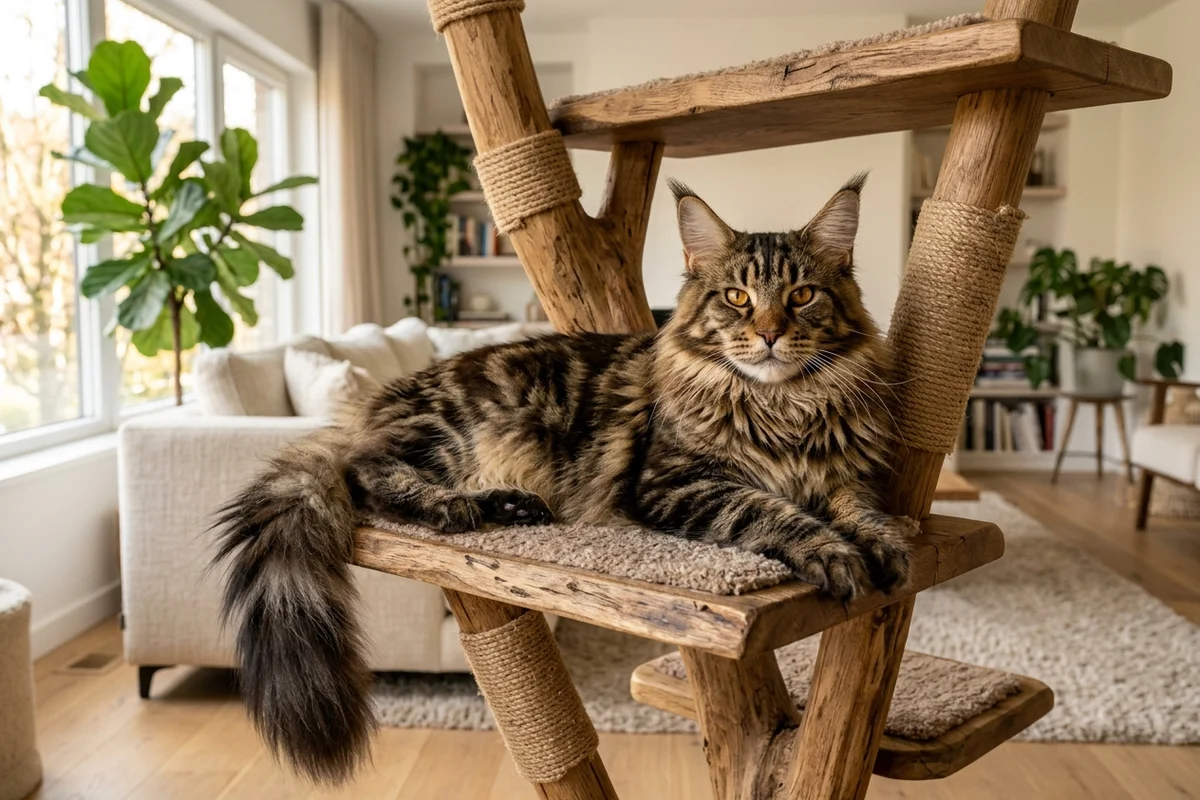
The Maine Coon proudly holds the title of the largest domestic cat breed on Earth. With its lion-like mane, ears crowned with lynx-like tufts, and an opulent, bushy tail reminiscent of a raccoon or fox, this native New England feline has captivated pet lovers across the globe. Yet behind this formidable physical presence lies an exceptionally sweet, placid, and affectionate temperament, earning the breed its universal moniker: the «gentle giant» of the cat world.
In this guide
Official Breed Factsheet (TICA, CFA and FIFe Standards)
| Biological Parameter | Official Maine Coon Standard | Veterinary & Breed Notes |
|---|---|---|
| Life expectancy | 12 to 15 years | Heavily contingent on proactive cardiovascular and joint management. |
| Adult male weight | 14.5 – 25.0 lbs (6.5 – 11.0 kg) | Must represent lean, dense muscular mass; avoid obesity. |
| Adult female weight | 10.0 – 16.5 lbs (4.5 – 7.5 kg) | Pronounced sexual dimorphism; females are noticeably lighter. |
| Total body length | 35 – 48 inches (90 – 120+ cm) | Holds the all-time Guinness World Record for domestic cat length. |
| Coat architecture | Semi-long, three-layered, water-repellent | Dense thermal undercoat shielded by glossy, oily guard hairs. |
| Full physical maturation | 36 to 60 months (3 to 5 years) | Prolonged skeletal growth spanning more than triple typical feline breeds. |
| Vocal repertoire | Melodic trills, chirps, and soft coos | Rarely voice harsh or repetitive yowling meows. |
| Registry recognition | Natural semi-longhair breed | Fully recognized by CFA, TICA, FIFe, GCCF, and WCF. |
---
Origin, Mythology, and Historical Reality
The Maine Coon is the only long-haired breed indigenous to the United States, originating in the rugged northeastern state of Maine, where it was designated the official state cat in 1985. Its history merges folklore with rugged natural selection:
```
European Ship Cats ──> Local Short-Haired Barn Cats ──> Harsh Maine Winters ──> Modern Maine Coon
(Norse / Maritime Traders) (Colonial New England Farms) (Extreme Natural Selection) (Official Global Breed)
```
The Raccoon Myth: A Biological Impossibility
For decades, New England folklore suggested the Maine Coon arose from romantic couplings between feral domestic cats and wild raccoons (Procyon lotor, lending the suffix Coon). From a biological and genetic standpoint, such hybridization is strictly impossible. Felines and procyonids belong to completely distinct taxonomic families (Felidae vs. Procyonidae), separated by millions of years of evolutionary divergence and incompatible chromosome numbers. The myth persisted solely due to the breed's bushy ringed tail in brown classic tabbies and their habit of picking up food with front paws.
The Maritime and Norse Heritage
Genomic analysis confirms that the breed descended from crossings between local American domestic shorthairs and long-haired maritime cats imported by European sailors and colonists. These seafaring ancestors included Scandinavian ships' cats (closely related to the modern Norwegian Forest Cat) as well as Angoras brought aboard merchant vessels from Europe and the Mediterranean to hunt shipboard rats.
Exposed to the unforgiving winters of coastal and inland Maine—marked by sub-zero temperatures and heavy snowpack—only cats with substantial muscular bulk, dense water-shedding fur, wide snowshoe paws, and keen hunting instincts survived and reproduced.
In 1895, at the inaugural North American cat championship at Madison Square Garden in New York City, a brown tabby female named Cosey won «Best in Show», cementing the Maine Coon's place in modern feline history.
---
Anatomical Features and Cold-Weather Adaptations
Every morphological characteristic of the Maine Coon is an evolutionary triumph engineered to withstand harsh winter conditions:
1. Head, Muzzle, and Profile
The head is medium to broad, slightly longer than wide, with high, prominent cheekbones. Its hallmark signature is the distinctly square, box-like muzzle, clearly defined under the cheekbones with a firm, blunt chin that forms a perpendicular 90-degree angle with the upper lip. In profile, there is a gentle, concave nasal curve (stop) without an extreme break or flat dish.
2. Lynx-Tufted Ears
The ears are tall, wide at the base, and set high on the head, tapered to a point. They feature two vital cold-weather defenses:
- Distal Lynx Tips: Tufts of stiff hair sprouting from the ear tips that minimize heat dissipation while lending the cat its wild, bobcat-like look.
- Internal Auricular Furnishings: Dense horizontal ear hair that shields the ear canal against icy winds, driven snow, and freezing rain.
3. The Triple-Layer Weatherproof Coat and Lion Ruff
The fur is not uniform in length: it stays relatively short over the shoulders and nape, lengthening gradually down the back, flanks, and lower belly, culminating in voluminous «britches» around the hind legs. It consists of a fine, insulating down undercoat covered by long, silky, water-repellent guard hairs that cause melting snow and water to run off effortlessly. Around the neck and chest, adults boast a magnificent frontal ruff that resembles a lion's mane.
4. Snowshoe Paws and Wrapping Tail
The legs are thick, sturdy, and heavily muscled, ending in enormous, round paws. Between every toe grow dense tufts of interdigital hair extending up to 1.5 inches (3–4 cm). These act as natural snowshoes, increasing surface area over snowdrifts and insulating delicate foot pads from direct ice contact.
The tail is as long as the cat's entire torso. When sleeping curled up in winter snow, the cat wraps this bushy plumed tail tightly around its face and paws, breathing through the fur to warm inhaled arctic air.
---
The Polydactyl Maine Coon Phenomenon
Historically, an estimated 40% of original native Maine Coons in the state of Maine were polydactyl, possessing extra digits on their front and sometimes hind paws (often 6 or 7 toes per foot, creating a «mitten» configuration).
- Original Functional Advantage: Driven by the dominant Pd gene, these oversized paws acted like even broader snowshoes on deep snow and granted exceptional grip when climbing icy ship rigging or navigating forest terrain.
- Cat Registry Status: In the mid-20th century, show-standard committees disqualified polydactyly to standardize show benches. However, TICA and specialized breed clubs now recognize the Maine Coon Polydactyl as an official trait division, honoring this historic heritage provided the cat exhibits sound bone conformation without harmful limb deviations.
---
Temperament and Ethology: «The Gentle Giant»
Despite their imposing size and lion-like silhouette, Maine Coons possess one of the most balanced, placid, and sweet temperaments in the animal kingdom:
```
Loving Companion Without Being Clingy ◄───► Gentle with Children & Dogs
▲ ▲
│ │
[ CORE TEMPERAMENT ] ────────────────► [ VOCAL REPERTOIRE ]
│ │
▼ ▼
Playful Water & Puzzle Lover Melodic Chirps, Trills & Coos
```
Social Living and Family Harmony
Maine Coons are sociable without being demanding lap pets. They rarely demand constant physical handling; instead, they prefer «room companionship», following you quietly from kitchen to home office, resting near your feet or observing household chores with benign curiosity. They exhibit extraordinary patience with young children and integrate smoothly with dogs of any size, their calm self-assurance defusing canine territorial tension.
Signature Sounds: The Maine Coon Trill
Unlike the loud, persistent meowing common in Siamese or Oriental breeds, the Maine Coon communicates using an endearing *chirp or rolling trill (trilling)*. This high-pitched, bubbly vibration is used to greet owners at the door, express delight during meal prep, or respond when addressed by name.
Fascination With Water
Many Maine Coons retain an instinctive love for water. Don't be surprised to find your Maine Coon dipping paws into water bowls, splashing water across tiles before drinking, perching on edge of bathtubs, or investigating a running faucet with uninhibited delight.
---
Prolonged Growth and Tailored Nutrition
Raising a Maine Coon is a developmental marathon. Providing inappropriate nutrition during their multi-year growth window can permanently compromise joint longevity and skeletal density.
| Life Stage | Age Span | Core Nutritional Priority |
|---|---|---|
| Lactation & Weaning | 0 to 8 weeks | Colostral passive immunity, transition to DHA-rich pediatric mousse. |
| Kitten Phase 1 | 2 to 12 months | Rapid cellular multiplication, precise calcium-to-phosphorus ratio (1.2:1). |
| Extended Juvenile Phase | 12 to 36 months | Controlled caloric density; continuous joint chondroprotection. |
| Adult Maintenance | 3 to 10 years | Lean muscle preservation, XXL kibble for jaw exercise, obesity prevention. |
| Senior Stage | > 10 years | Renal sparing phosphorus limits, cardiac taurine/L-carnitine, mobility care. |
The Value of Giant-Specific Kibble
Due to their broad, square jaws, Maine Coons tend to swallow standard cat kibbles whole without crunching. Breed-specific diets feature extra-large cubic or emerald-shaped kibble, forcing the cat to actively grasp, crunch, and chew. This slows down ingestion, reduces regurgitation, stimulates saliva production, and provides mechanical tooth scrubbing to reduce calculus buildup.
Early Joint Chondroprotection
Because a heavy frame places constant mechanical strain on hips, hocks, and stifles, Maine Coon diets must contain guaranteed levels of glucosamine, chondroitin sulfate, and marine Omega-3 fatty acids (EPA and DHA) starting from kittenhood to nourish articular cartilage and cushion joint surfaces.
For monthly kitten feeding schedules, consult our comprehensive guide on what do kittens eat by age.
---
Genetic Health and Mandatory Veterinary Screening
As a giant breed with a closed gene pool, the Maine Coon is predisposed to specific hereditary conditions recognized in veterinary clinical genetics:
```
Condition Diagnostic Test Screening Timeline Veterinary Best Practice
──────────────────────────────────────────────────────────────────────────────────────────────────────────
Hypertrophic Cardio DNA test (A31P) + Echo DNA at weaning; Annual Echo Annual Doppler echo from 18 mo
Hip Dysplasia (HD) Ventrodorsal X-rays (OFA/BVA) Completed after 24 months Certify prior to breeding
Spinal Muscular Atrophy DNA Panel (Deletional mutant) Once in lifetime (DNA swab) Clear non-carrier status
Polycystic Kidney (PKD) Ultrasound + DNA test Kitten / Young adult Rule out renal cyst parenchyma
```
1. Feline Hypertrophic Cardiomyopathy (HCM)
HCM is the most prevalent feline cardiac disease, causing concentric thickening of the left ventricular muscular walls. Over time, diastolic filling volume diminishes, predisposing the cat to congestive heart failure, pulmonary edema, aortic thromboembolism (saddle thrombus), or sudden collapse.
- The Genetic Mutation: The A31P point mutation in the cardiac myosin binding protein C gene (MYBPC3) is strongly associated with HCM in Maine Coons.
- Crucial Diagnostic Reality: A negative DNA test (clear) does not guarantee total immunity, as other unmapped mutations can cause cardiomyopathy. Therefore, annual Doppler echocardiograms performed by a board-certified veterinary cardiologist starting at 18 to 24 months are the gold standard for breeding and early medical intervention.
2. Feline Hip Dysplasia (HD)
Hip dysplasia occurs with notable prevalence in Maine Coons due to their massive bone mass and rapid growth kinetics. Laxity in the coxofemoral joint causes abnormal joint incongruity, triggering early cartilage erosion and painful degenerative osteoarthritis. Maintaining a lean body condition score (BCS 4-5/9) and using joint supplements is essential.
3. Spinal Muscular Atrophy (SMA)
An autosomal recessive hereditary disorder characterized by the loss of spinal motor neurons. Affected kittens display muscle weakness, tremors, and a peculiar unsteady, swaying gait in the hindquarters starting around 12 to 16 weeks of age. A simple, conclusive DNA swab test can verify non-carrier status.
4. Juvenile Gingivostomatitis
Many young Maine Coons experience severe juvenile hyperplastic gingivitis during permanent tooth eruption (between 5 and 10 months). Early home oral hygiene habits and veterinary cleanings prevent progression to chronic periodontitis.
---
Coat Care, Grooming, and Home Environment
While the silky texture of the Maine Coon's coat tangles less easily than the cottony undercoat of the Persian cat, regular grooming is required:
- Grooming Frequency: 2 to 3 sessions per week (10 to 15 minutes each). During seasonal shedding in spring and autumn, daily combing is required to remove dead undercoat before it felts into mats.
- Essential Professional Tools:
- Wide-toothed stainless steel comb (Buttercomb style): Glides through outer guard hairs down to the skin without snapping hair shafts.
- Soft pin slicker brush: Perfect for fluffing the frontal lion ruff and full hind britches.
- Undercoat rake: Gently extracts trapped dead down hair during seasonal coat drops.
- High-Risk Friction Zones: Regularly check under the armpits, the inner groins, behind the base of the ears, and along the lower belly where friction creates tight knots.
- Hairball Management: Large amounts of ingested hair during daily self-grooming can form painful gastric trichobezoars. If your cat retches or vomits hair, review our guide on what to do when a cat vomits and offer feline malt paste twice weekly.
- Heavy-Duty Scratching Furniture: Standard lightweight scratching posts will snap under a 20-lb Maine Coon. Invest in heavy posts with trunk diameters of at least 6 to 8 inches (15–20 cm) mounted on solid wood weighted bases. Review our guide on why cats scratch furniture and choosing scratching posts.
---
Breed Comparison: Maine Coon vs. Norwegian Forest Cat vs. Siberian
These three magnificent natural semi-longhair breeds are frequently mistaken for one another. Here is how to distinguish them:
| Key Distinctive Trait | Maine Coon | Norwegian Forest Cat (Wegie) | Siberian Cat |
|---|---|---|---|
| Head Shape | Modified wedge, high cheekbones, distinctly square muzzle. | Equilateral triangle, smooth continuous contour lines. | Modified wedge with rounded contours, soft barrel cheeks. |
| Nasal Profile | Concave curve with gentle stop at eye level. | Completely straight profile, no nasal stop. | Gentle slight concave dip, convex towards tip. |
| Eye Shape & Aperture | Large, slightly oval, set at a slight oblique slant. | Almond-shaped, highly expressive, tilted obliquely. | Large, nearly round, set wide apart. |
| Ear Structure | Very large, wide base, prominent lynx tufts at apex. | Large, triangular, continuing outer lines of the head. | Medium, rounded tips with generous interior ear furnishings. |
| Torso & Musculature | Long, rectangular body, broad chest, muscular mass. | High on legs, triangular body, hind legs noticeably longer. | Compact, barrel-shaped torso, arched backline. |
| Coat Feel & Weight | Silky, heavy drape, three-layer weather-resistant coat. | Harsh, woolly, heavily water-repellent outer guard hair. | Extremely dense triple coat, tight impermeable undercoat. |
| Geographic Origin | United States (Maine). | Norway (Scandinavian forests). | Russia (Siberian river basin). |
---
Frequently Asked Questions (FAQ)
Can a Maine Coon live comfortably in a small apartment?
Yes, absolutely. Maine Coons are gentle, moderate-energy companions that adjust well to apartment life provided their vertical space is expanded. You will need an extra-large litter box (minimum 28–30 inches / 70–75 cm long), floor-to-ceiling sturdy cat trees anchored to walls, and dedicated daily interactive playtime.
How much does it cost to feed and maintain a Maine Coon monthly?
Because an adult Maine Coon consumes approximately 40% to 60% more calories than an average 9-lb domestic cat, requires premium high-protein joint-supplemented food, and uses substantial litter volumes, expect average monthly upkeep costs of $70 to $110 USD / €65 to €100 EUR, excluding routine preventive veterinary care.
How do I identify a reputable, ethical Maine Coon breeder?
A trustworthy breeder must always provide:
- Certified lab genetic test results (UC Davis, Laboklin, or Wisdom Panel) proving both parents are clear of HCM (A31P), SMA, and PKD.
- Official board-certified veterinary cardiologist Doppler echocardiogram certificates performed within the past 12–18 months.
- Official certified pedigree registered with TICA, CFA, FIFe, or GCCF.
- Up-to-date core vaccinations, microchip registration, and a formal written health guarantee.
- Kittens are never released before 12 to 14 weeks of age, fully socialized, vaccinated, and litter-trained.
---
The Maine Coon is far more than a stunning feline giant—it is a loyal, serene, and deeply affectionate life partner whose melodic chirps and majestic companionship enrich any home.
Create an Account — Register for free to unlock all Nekolife breed and health encyclopedias.
---
Related Guides
- Persian Cat: Characteristics, Care, and Health
- Comprehensive Kitten Care Guide: 0 to 12 Months
- What Do Kittens Eat: Food and Portions by Age
- How Much Do Kittens Sleep: Normal Sleep Patterns
- Why Cats Scratch Furniture and How to Train Them to Use Scratchers
- Deworming Kittens: When and How to Treat Parasites
- How to Bathe a Kitten for the First Time Without Stress
- Nekolife Feline Community
---
Caring for a cat? Keep their health in your pocket
Register your cat on Nekolife to track vaccination history, weight, and get advice from loving cat parents.
- Vaccine & weight records
- Supportive cat community
- Earn Meow Points & badges
Related pages
Sources
- "Maine Coon Breed Standard and Characteristics". The International Cat Association (TICA), 2024. tica.org
- "Maine Coon Cat Breed Profile". The Cat Fanciers' Association (CFA), 2023. cfa.org
- "Hypertrophic Cardiomyopathy (HCM) in Maine Coon Cats: Mutation A31P in MYBPC3 gene". Veterinary Genetics Laboratory, University of California, Davis (UC Davis). vgl.ucdavis.edu
- "Spinal Muscular Atrophy (SMA) in Maine Coon Cats". UC Davis School of Veterinary Medicine. vgl.ucdavis.edu
- "Feline Hip Dysplasia: Prevalence and Clinical Relevance in Purebred Cats". Journal of Feline Medicine and Surgery. journals.sagepub.com
- "Breed-Specific Health Considerations for Maine Coon Cats". International Cat Care (iCatCare), 2024. icatcare.org
Know someone who needs this?