Birman Cat (Sacred Cat of Burma): Breed Profile, History, and Care
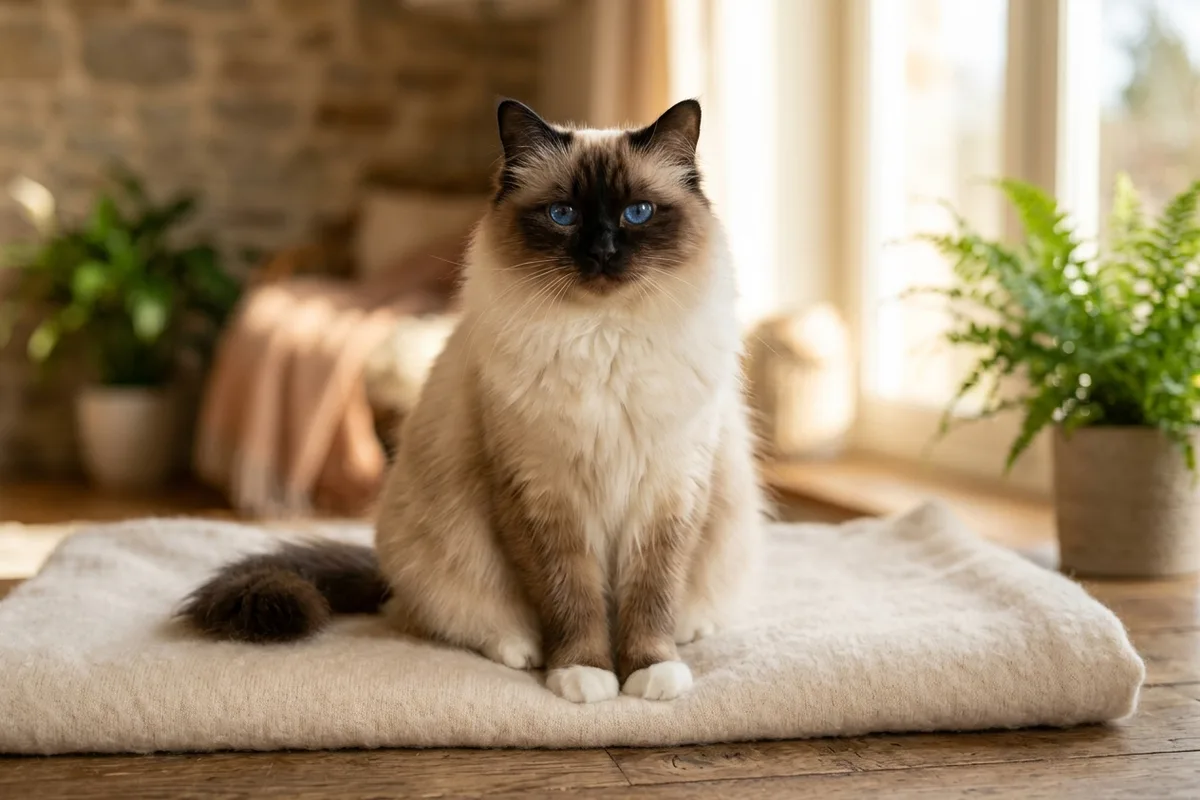
The Birman cat (also known as the Sacred Cat of Burma) is one of the most enchanting and aristocratic breeds in the feline world. Enveloped in mystical legends of golden Burmese temples, this elegant cat instantly commands attention with its captivating contrast: a golden-fawn or warm cream body, darker colourpoint extremities, piercing deep sapphire blue eyes, and its crowning hallmark: four immaculate snow-white gloved paws. With an exceptionally gentle, loving, and balanced temperament, the Birman is widely regarded as the ultimate family companion.
In this guide
1. The Buddhist legend and true history of the breed
The allure of the Sacred Birman begins with an ancient temple legend:
> In the secluded temples of Burma, high priest Mun-Ha meditated before Tsun-Kyan-Kse, the golden goddess with sapphire eyes, guarded by his pure white cat Sinh. When temple marauders struck the priest down, Sinh sprang onto his dying master's chest. Miraculously, the cat's fur absorbed a warm golden radiance from the sun, his eyes turned deep sapphire blue like the goddess's, and his ears, face, and tail darkened to the color of the earth. Only his paws, resting on his pure master's robe, remained dazzling snowy white as an eternal mark of devotion.
Historically, the breed was recognized in France in 1925 under the name Sacré de Birmanie. After World War II reduced the breed to a single surviving pair in Europe, dedicated French and European breeders meticulously restored the lineage by crossing with Persians and seal-point Siamese, preserving their iconic gloves and silky coat.
---
2. Physical characteristics: The secret of the white gloves
| Feature | Official Standard (FIFe / TICA / CFA) |
|---|---|
| Adult Weight | Males: 10 – 14 lbs (4.5 – 6.5 kg) · Females: 7.5 – 10 lbs (3.5 – 4.5 kg) |
| Head and Profile | Broad, slightly rounded skull, full cheeks, and a distinctive Roman nose with a gentle dip |
| Eyes | Almost round, expressive, and always an intense, vivid sapphire blue |
| Coat & Texture | Semi-long, luxuriantly silky, forming a heavy ruff around the neck without a woolly undercoat |
| Gloves & Laces | Pure white gloves ending at the toes in front; extending up the back of the hind legs into symmetrical "V" spurs |
| Color Points | Seal point, Blue point, Chocolate point, Lilac point, Red point, Cream, and Tortie points |
Birman kittens are born entirely white. Point coloration and white gloves begin developing within two weeks, taking up to two full years to reach complete richness.
---
3. Temperament: The sweet golden mean
The Birman is celebrated worldwide for its placid, loving demeanor:
* Soft, chirping voice: They communicate through gentle chirps and quiet meows rather than loud vocal demands.
* Devoted and sociable: They thrive in the presence of humans, following owners from room to room, but maintain a polite, respectful independence.
* Harmonious with multi-pet homes: Their peaceful nature helps them easily befriend calm dogs and polite children.
---
4. Grooming and nutrition
Unlike the high-maintenance Persian cat, the Birman's coat is a joy to manage:
- Twice-weekly brushing: A stainless-steel pin brush is sufficient to remove loose hairs and maintain coat sheen.
- Hairball management: During spring and autumn shedding periods, supplement with malt paste or fiber treats.
- Omega fatty acids: Choose foods rich in EPA and DHA (salmon oil) to nourish their silky mantle.
- Claw care: Keep claws safely trimmed every couple of weeks with our guide on how to trim cat nails safely.
---
5. Genetic health and preventive veterinary care
Birmans enjoy a healthy lifespan of 12 to 16 years. Responsible breeders screen for:
* Hypertrophic Cardiomyopathy (HCM): A thickening of the heart muscle walls. Periodic echocardiograms are recommended for breeding cats.
* Feline Hypokalemia: Inherited potassium deficiency causing neck muscle weakness, testable through DNA screening.
* Kidney protection: Ensuring high water intake prevents chronic feline kidney disease. Read how to get a cat to drink water.
---
6. Comparison: Birman vs Ragdoll vs Siamese
```
┌─────────────────────────┬─────────────────────────┬─────────────────────────┐
│ BIRMAN CAT │ RAGDOLL CAT │ MODERN SIAMESE │
├─────────────────────────┼─────────────────────────┼─────────────────────────┤
│ - Medium size (8-13 lbs)│ - Large/Giant (12-20 lbs│ - Slender/fine (6-9 lbs)│
│ - Mandatory white gloves│ - Bicolor/mitted or color│ - Dark paws without w. │
│ - Silky single-layer fur│ - Dense plush coat │ - Very short flat coat │
│ - Soft melodious voice │ - Placid, collapses limp│ - Loud, vocal meow │
└─────────────────────────┴─────────────────────────┴─────────────────────────┘
```
---
7. Frequently asked questions (FAQ)
Why are my Birman kitten's paws and body completely white?
This is due to the temperature-sensitive Himalayan gene: pigment is only produced in cooler extremities (ears, nose, paws, tail) as kittens grow in room temperature.
Do Birman cats shed a lot?
Because they lack a dense downy undercoat, they shed considerably less than other longhaired breeds and rarely produce mats.
---
Sources and official breed standards
- Fédération Internationale Féline (FIFe): Birman Breed Standard (SBI).
- The International Cat Association (TICA): Sacred Birman Breed Group Standard.
- Cat Fanciers' Association (CFA): Birman Breed Profile & Judging Criteria.
- Journal of Feline Medicine and Surgery: Genetic screening for familial hypertrophic cardiomyopathy in purebred cats.
Caring for a cat? Keep their health in your pocket
Register your cat on Nekolife to track vaccination history, weight, and get advice from loving cat parents.
- Vaccine & weight records
- Supportive cat community
- Earn Meow Points & badges
Related pages
Know someone who needs this?